

...in full swing, with this upcoming flight’s two telecommunications relay platforms—Amazonas 3 and Azerspace/Africasat-1a— undergoing their checkout procedures at the Spaceport. The Amazonas 3 spacecraft began its pre-launch activity inside the Spaceport’s S1B clean room facility, following an arrival in French Guiana earlier this month aboard a chartered cargo jetliner. Amazonas 3 will have a liftoff mass of 6.2 metric tons, and carries Ka-, Ku- and C-band transponders for telecommunications services across the Americas, along with Europe and North Africa. Its Ka-band payload positions the HISPASAT Group as Latin America’s first operator capable of offering interactive services and multimedia applications via satellite to a large number of users. The spacecraft was built by Space Systems/Loral in Palo Alto, California, based on the company’s 1300-series platform. To be positioned at an orbital location of 61 degrees West, it will deliver services that include direct-to-home television, corporate fixed and mobile telephone networks and broadband.
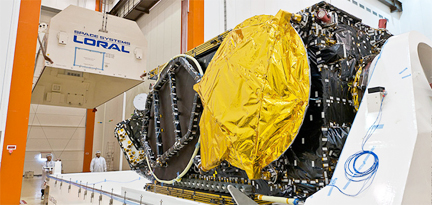
Amazonas 3 will be orbited on Ariane 5’s February 7 mission along with the Azerspace/Africasat-1a spacecraft, which continues its own preparation activity at the Spaceport. Built by Orbital Sciences Corporation under contract to the Republic of Azerbaijan's Ministry of Communications and Information Technologies, Azerspace/Africasat-1a will weigh approximately 3,250kg. at liftoff, and is to deliver communications services to Azerbaijan, Central Asia, Europe and Africa from an orbital location of 46 degrees East.
This upcoming mission will be the 68th flight of Arianespace’s Ariane 5 from French Guiana, and it is to kick off the company’s 2013 launch activity with its heavy-lift workhorse. A total of six Ariane 5 flights are scheduled from the Spaceport this year, along with four medium-lift Soyuz launches and one with the light-lift Vega.
Additionally, six Globalstar satellites have been integrated on their dispenser for orbiting on the next...
...Soyuz flight operated by Starsem, which is Arianespace’s Euro-Russian affiliate responsible for commercial missions with this medium-lift launcher at the Baikonur Cosmodrome. During activity in Starsem’s clean room facilities at the Cosmodrome, the satellite dispenser system’s upper mast section was mated with the lower mast portion, creating a 6.7-meter-tall unit that contains the complete payload “cluster.”
Two of the 700kg.-class Globalstar spacecraft are installed on the mast’s upper portion and will be deployed first during the February 4th flight, while the remaining four satellites are positioned on the lower section for their subsequent release in the mission sequence.
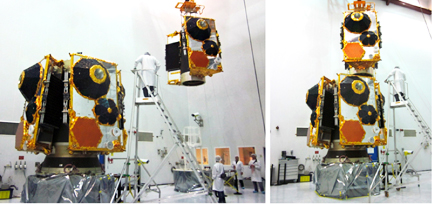
The Soyuz payload dispenser system’s upper mast with two Globalstar satellites is moved into position for mating with the lower portion which holds four more spacecraft (photo at left). The mating operation nears completion (photo at right) to create a 6.7-meter-tall unit.
These satellites—supplied by Thales Alenia Space—are trapezoidal in shape, allowing them to be installed around the conical payload dispenser. They represent the final batch in Globalstar’s second-generation constellation, which provides products including relay capacity for mobile and fixed satellite telephones, simplex and duplex satellite data modems and flexible service packages.
The upcoming Starsem mission is the final of four flights currently contracted to Arianespace for orbiting the second-generation Globalstar constellation, wrapping up a series of launches that started in October 2010, and continued in July and December 2011. It will be the 26th performed by Starsem since beginning operations at Baikonur Cosmodrome in 1999 on a historic introductory commercial Soyuz flight also at the service of Globalstar—carrying four of its first-generation constellation satellites.