

 [SatNews] The Boeing Company [NYSE: BA] has successfully demo'd a SOTM product as well as delivered NASA three flight computer software test beds, the first ...
...critical element for flight software development in support of NASA's Space Launch System (SLS). Flight software controls the launch vehicle during preflight tanking operations and in flight. The test beds were delivered on April 25, ahead of schedule, to the Software Development Facility at NASA's Marshall Space Flight Center in Huntsville. They are now being integrated with NASA's application software.
In triple modular redundant processing, three processors within each flight computer interpret the data, then "vote" to be sure they all agree on the response before sending that solution from the computer. The three flight computers on the vehicle then compare those answers and send commands to the vehicle for execution. "The triple redundant processors make each computer reliable in the harsh radiation environment. Similarly, the three computers working in concert make the vehicle reliable," said Richardson. "The configuration is called the flight computer operating group."
In 2011, NASA executed a contract modification that changed existing Upper Stage Production and Instrument Unit Avionics contracts into a single contract for design, development and production of the cryogenic stages and avionics for SLS. SLS will provide an entirely new capability for human exploration beyond Earth orbit. With its ability to conduct both crew and cargo missions, it also will back up commercial and international-partner transportation services to the International Space Station.
Under NASA's phased development plan for SLS, Boeing is designing the two cryogenic stages concurrently to maximize the affordability of rocket development and operations. The initial flight-test configuration, scheduled to fly in 2017, will provide a 70-metric ton capacity using only the first stage. The complete two-stage vehicle configuration will provide a lift capability of more than 130 metric tons to enable missions beyond Earth orbit and support deep space exploration.
The demonstration in May connected three sites in Australia and the United States using integrated voice, video, and data communications over the increased bandwidth available on the latest generation Ka-band satellite mobile terminals. This capability uses the Wideband Global SATCOM (WGS) system, also developed by Boeing. During the demo, High Mobility Multipurpose Wheeled Vehicles (Humvees) fitted with cameras and handheld radios successfully connected to test labs in Australia and the United States, simultaneously combining videoconferencing with military radio and telephones. The integrated SOTM demonstration proved core elements of a seamless, secure and deployable communications system.
This latest SOTM product evolved from combat-proven technologies used by the U.S. Army during Operation Iraqi Freedom in 2003. "This demonstration shows the maturity and readiness of Boeing's capabilities in the suite of services required to provide satellite communications on the move," said Kim Gillis, vice president and managing director of Boeing Defence Australia. "Our proven SOTM technology will provide defense customers with confidence that HQ on the Move capability can be achieved on the Ka-band satellite system ready for the WGS network."
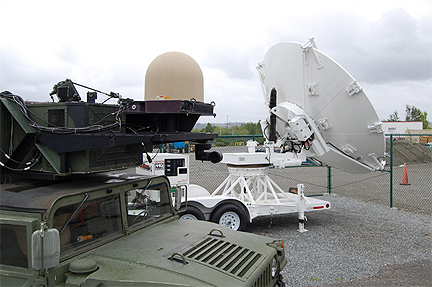
Boeing SOTM technology is a leap forward in Ka-band satellite network communication capabilities for the warfighter.