

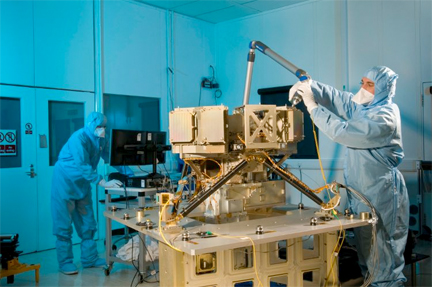
MIRI during ambient temperature alignment testing at the Science and Technology Facilities Council’s Rutherford Appleton Laboratory, in the U.K.
Image credits: STFC / Stephen Kill
...it could see a candle on one of Jupiter’s moons, has been declared ready for delivery by the European Space Agency and NASA. The MIRI Optical System, an instrument for the James Webb Space Telescope (JWST) that will eventually take up a position four times further away from the Earth than the Moon. It will now be shipped to NASA’s Goddard Space Flight Center where it will be integrated with the other three instruments and the telescope.
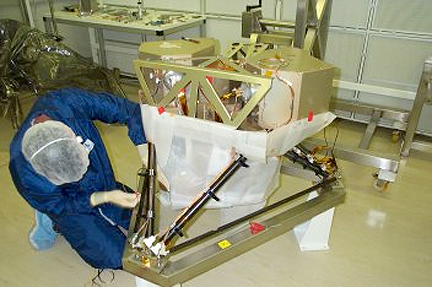
Template development for JWST MIRI cryogenic mult-layer insulation. Image courtesy of STFC RAL Space.
MIRI will allow astronomers to explore the formation of planets around distant stars and could even pave the way for investigations into the habitability of other planetary systems. MIRI offers a sensitivity and resolution many times greater than any other mid-IR instrument in existence today or for the foreseeable future. It will be able to penetrate the dust obscuring distant objects, allowing for smaller and fainter objects than have ever been detected to be mapped in unprecedented detail. Its wavelength of 5 to 28 microns brings a unique scientific capability among the other instruments on the James Webb Space Telescope. MIRI will therefore have a key role in the study of light that has travelled from the early moments of the universe by JWST. These wavelengths bring additional technical challenges due to the extremely low operating temperatures necessary (-266.5ºc). Unlike the other JWST instrument,s MIRI will be cooled by a dedicated cooler provided by JPL.
Facilities at STFC’s Rutherford Appleton Laboratory had to be specially designed to simulate the environment the instrument will experience in space and account for it’s extremely low operating temperatures. The instrument was assembled from major sub-systems that had already been built-up and thoroughly tested in the partner institutes. The RAL test chamber was then used to test the performance of all the scientific operating modes of the instrument and obtain critical calibration observations. Such rigorous testing promotes confidence in the science it will do when the mission is launched, which is scheduled for 2018.