European Space Agency... Verification By Vacuum (Manufacturing)
[SatNews] It's a harsh world for satellites, and a new meteorological satellite has just passed the vacuum test.
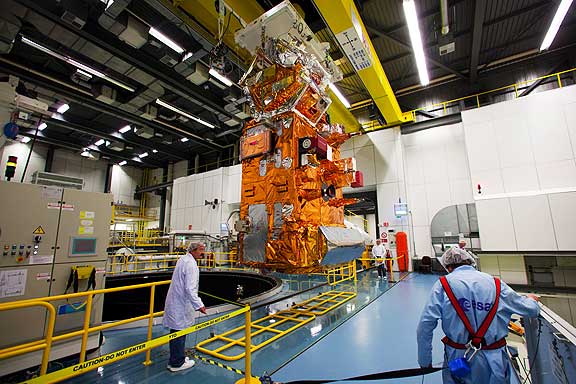 MetOp-B Payload Module lifted out of ESTEC's Large Space Simulator on 28 July 2010, after more than a month of tests. Credits: ESA/Sander Koenen
The
Payload Module of
ESA’s latest meteorological satellite,
MetOp-B, has been hauled out of the largest vacuum chamber in Europe: its ability to operate in the harsh conditions of space has been proved. After more than a month of testing in ESA’s
Large Space Simulator (
LSS) at
ESTEC in the Netherlands, MetOp-B’s Payload Module was lifted out of the vacuum chamber on 28 July. The module hosts all of the sensitive meteorological instruments. It had been placed within the LSS to recreate space conditions here on Earth. The largest simulator of its kind in Europe — big enough to accommodate a double-decker bus standing upright —- the LSS subjected the module to space-quality vacuum and temperatures ranging from upwards of 100 degrees C down to 120 degrees below zero.
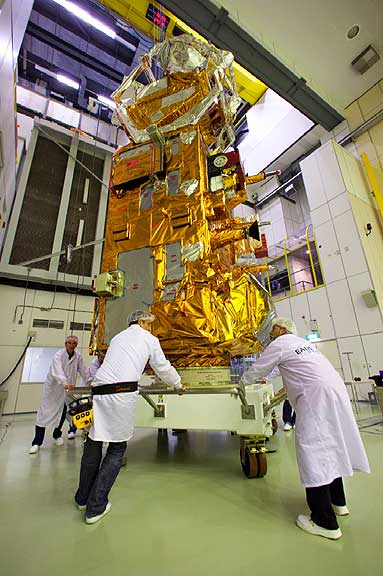 Payload Module moved after being lifted from ESTEC's Large Space Simulator on 28 July 2010. MetOp-B's Payload Module is the segment of the satellite that hosts its meteorological instruments. Credits: ESA/ Sander Koenen
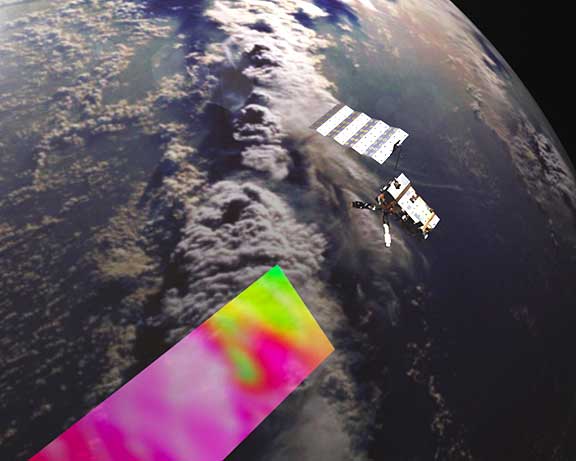 MetOp-A is Europe's first polar orbiting satellite dedicated to operational meteorology, and with its contribution to the American Polar Orbiting Environmental Satellite (POES) Programme it marks a new era in global weather prediction and climate monitoring. From its polar orbit 800 kilometres above the surface of the Earth, MetOp's range of European and American instruments will provide a wealth of accurate and detailed information to meteorologists and scientists around the world. MetOp-A was launched on 19 October 2006 from the Baikonur Cosmodrome in Kazakhstan, on a Soyuz ST rocket with a Fregat upper stage. Credits: ESA - AEOS Medialab
The MetOp-B team worked with
ESTEC Test Centre personnel to prepare for the Payload Module’s ‘liberation’. The multi-layer insulation-covered module was lifted up out of the LSS slowly and with maximum precision. The mission team monitored every millimetre-scale movement until the satellite was safely on its stand in the adjoining clean room. The entire process took three hours to complete. After final checks at the ESTEC Test Centre, the module will be transported at the start of August to payload module contractor
EADS Astrium, in Friedrichshafen, Germany, where it will be temporarily stored, waiting for the final precise calibration of some European and American instruments. Next year, it will journey to Toulouse, where EADS Astrium prime contractor will attach it to the Service Module and the solar panels. Finally, MetOp B will be transported to Baikonur in Kazakhstan for launch on a
Soyuz rocket in the spring of 2012.
MetOp-B is the second in a series of three European meteorological operational satellites procured by ESA to serve as the space segment of the
European Organisation for the Exploitation of Meteorological Satellites'
EUMETSAT Polar System (
EPS). The first in the series,
MetOp-A, was launched into polar orbit in 2006.
MetOp-C is scheduled for launch in 2016.
Topical Tags :
Regional Tags :

