

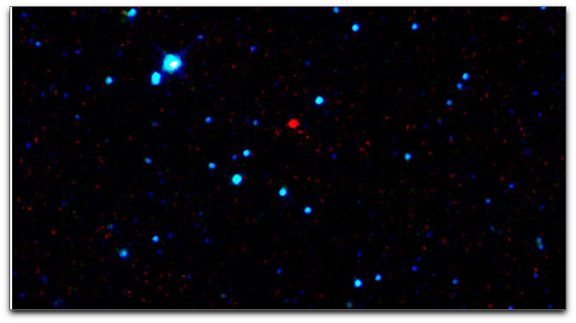
The red dot at the center of this image is the first near-Earth asteroid discovered by NASA's Wide-Field Infrared Survey Explorer, or WISE Image credit: NASA/JPL-Caltech/UCLA
After the mission's sophisticated software picked out the moving object against a background of stationary stars, researchers followed up and confirmed the discovery with the University of Hawaii's 2.2-meter (88-inch) visible-light telescope near the summit of Mauna Kea. The asteroid is currently about 158 million kilometers (98 million miles) from Earth. It is estimated to be roughly 1 kilometer (0.6 miles) in diameter and circles the sun in an elliptical orbit tilted to the plane of our solar system. The object comes as close to the sun as Earth, but because of its tilted orbit, it is not thought to pass near our planet. This asteroid does not pose any foreseeable impact threat to Earth, but scientists will continue to monitor it. WISE, which began its all-sky survey on January 14th, is expected to find about 100-thousand previously undiscovered asteroids in the Main Belt between Mars and Jupiter, and hundreds of new near-Earth asteroids. It will also spot millions of new stars and galaxies.