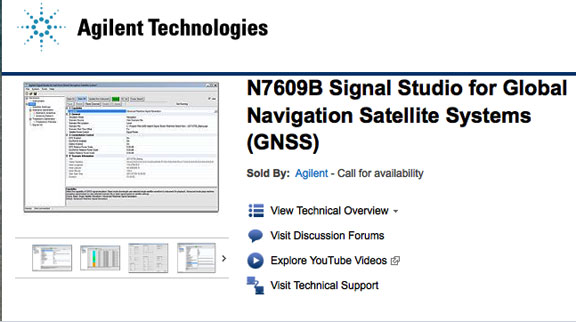
...enhanced with real-time and basic mode capabilities designed to allow engineers to simulate Galileo signals for receiver testing and to address the needs of the manufacturing test market. Signal Studio’s new capability, comprising the Advanced Galileo real-time mode and the Scenario Generator for Advanced Galileo, allows users to perform real-time, multi-satellite simulation for the European Galileo system. Galileo is a satellite-based navigation system similar to the United States’ Global Positioning System (GPS) and the Russian GLONASS system. While the full system (including 27 operational satellites and three active spares) is not expected to be completed until 2019, Galileo-ready chipsets and receivers are available today.
Agilent’s Advanced Galileo software supports these development efforts by allowing engineers to generate signals that simulate Galileo satellites or a combination of Galileo, GPS and/or GLONASS satellites. With the Scenario Generator for Advanced Galileo, users can create custom scenarios (simulating stationary or moving receivers) for specific locations, dates and times that contain Galileo satellites. Such capabilities are targeted at engineers designing or testing GNSS chipsets, modules, components or receivers, as well as mobile devices providing navigation or location-based services.
Signal Studio’s new basic-mode capability is available via the Basic Single Satellite Waveform option. It provides engineers with single satellite waveform files that can be used for simple receiver testing in manufacturing and other applications. In addition to GPS, GLONASS and Galileo, waveform files are also available for the Chinese Compass/Beidou2 system,