

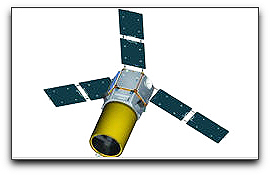
 ORS-1 is part of the United States Department of Defense's (DoD) ORS program that focuses on using small satellites and launch vehicles to provide innovative sensor technologies to the commanders in the battlefield, and doing so in shortened timeframes and in more affordable ways. The ORS-1 program supports Intelligence, Surveillance and Reconnaissance (ISR) needs, by providing innovative sensor systems that range across multiple spectrums. The satellite bus is based on the design ATK developed for the successful TacSat-3 satellite with the addition of a propulsion module. ATK built the bus at its Beltsville, Maryland, facility. One of the goals of the program is to develop satellite buses with standard interfaces that allow for different sensors to be used for specific missions. TacSat-3 was the earlier demonstration program that led to ORS-1. It was successfully launched last year and continues to perform well as an operational resource.
ATK is under contract to Goodrich, the overall spacecraft integrator of the ORS-1 satellite system. ORS-1 will provide color pictures of regions selected by ground force commanders, and use existing ground systems to process and distribute the images and other information out to the battlefield. The system is designed to support urgent military needs, while establishing a foundation that will advance the multi-mission modular approach required for future ORS satellites. The Operationally Responsive Space Office (ORS Office) is a joint initiative of several agencies within the DoD responsible for integrating joint ORS capabilities and for applying ORS resources to the development, acquisition and demonstration of capabilities to meet specific responsive space needs as established by global combatant command joint force commanders and users. The ORS-1 Program is managed by the Space Development and Test Wing located at Kirtland Air Force bBse with support from the ORS Office.