The HIFI instrument onboard ESA's Herschel observatory has been successfully switched on, after being inactive for more than 160 days due to an unexpected anomaly in the electronic system. This achievement brings
Herschel back to its full observing capacity.
)
The Heterodyne Instrument for the Far Infrared (HIFI) is a very high-resolution heterodyne spectrometer. It works by mixing the incoming signal with a stable monochromatic signal, generated by a local oscillator, and extracting the frequency difference for further processing in a spectrometer. HIFI will have seven separate local oscillators covering two bands from 480-1250 GHz and 1410– 1910 GHz. The instrument was developed by a consortium led by SRON Netherlands Institute for Space Research. Courtesy of ESA
was built specifically to observe water in a variety of celestial objects. Over the next three years, HIFI spectra will be used to probe stellar environments and to study the role of gas and dust in the formation of stars and planets and the evolution of galaxies. The quality of the first spectra obtain with HIFI on June 22 , 2009, effectively demonstrated the versatility of the instrument and showed that its accuracy and resolution exceeded specifications. On August 3, 2009, early in the performance verification phase, it was discovered that HIFI was no longer operating normally. This was later traced to an unexpected voltage peak in the electronics of HIFI’s
Local Oscillator Control Unit (LCU) having shut it down.
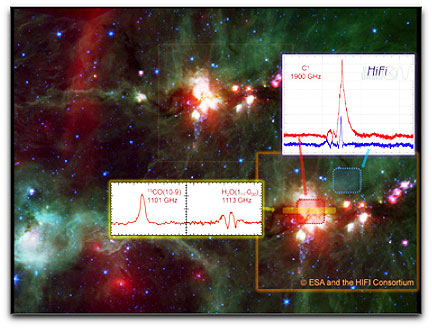
HIFI obtained its first spectra on June 22, 2009, during the in-orbit commissioning phase of the Herschel mission.
In case of such events, HIFI has a redundant set of electronics including the LCU which provides full functionality. However, before it was used, ESA and the HIFI consortium wanted to fully understand the cause of the problem. Following the shut down of HIFI, the consortium, joined by ESA, carried out a detailed and thorough investigation before making the necessary adaptation to software that monitors the LCU to prevent the problem from happening again. All tests have confirmed that the LCU back-up system is functioning perfectly after switch-on last week. In addition, the HIFI sensors are performing with the same high quality as they did when they captured the spectra of the warm molecular gas in the
DR21 star-forming region in
Cygnus. This spectra showed clear evidence for water, as well as for singly ionized carbon (a key diagnostic for molecular cloud material), and carbon monoxide.
HIFI was built specifically to observe water in a number of different celestial targets as part of the investigation into the role of gas and dust in the formation of stars and planets, and the evolution of galaxies. The successful activation of HIFI comes as an important target, the star forming regions of the
Orion Nebula or
M42, approaches the instruments field of view.
Topical Tags :
Regional Tags :

