

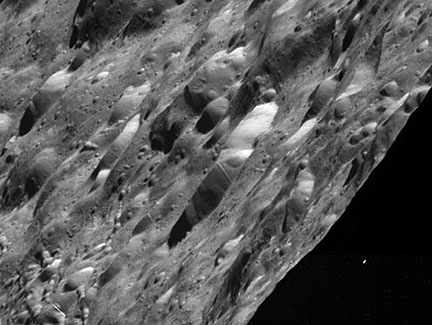
This raw image obtained by NASA's Cassini spacecraft of Saturn's moon Rhea shows craters in an area between day and night on the icy moon. The bright spot to the right is likely a cosmic ray hit.Image credit: NASA/JPL/SSI
Pictures of the Rhea surface taken around the time of closest approach at 4:53 a.m. UTC on Jan. 11, 2011, which was 10:53 p.m. PST, Jan. 10, show shadowy craters at a low sun angle. A portrait of bright, icy Rhea also captures Saturn's rings and three other moons clearly visible in the background. Images obtained by Cassini's imaging science subsystem show an old, inert surface saturated with craters, just like the oldest parts of Earth's moon. But there appear to be some straight faults that were formed early in Rhea's history, which never developed the full-blown activity seen on another of Saturn's moons, Enceladus.
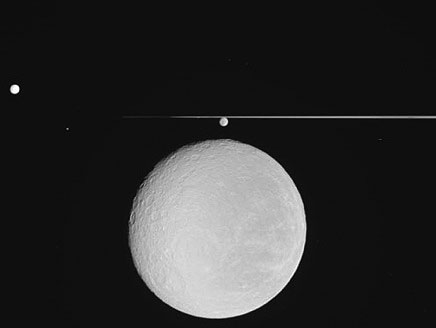
NASA's Cassini spacecraft captured this image showing Saturn's icy moon Rhea taking center stage, with cameo appearances by Saturn's rings and three clearly visible moons. Image credit: NASA/JPL/SSI
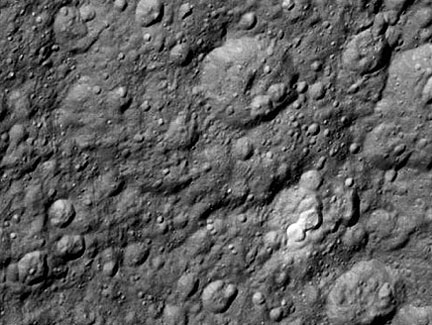
In this image obtained by NASA's Cassini spacecraft on its closest flyby of Saturn's moon Rhea, the heavily cratered surface of the moon appears in great detail. Just to the bottom right of the center of this image, a bright area appears to indicate a freshly excavated double crater. Image credit: NASA/JPL/SSI