

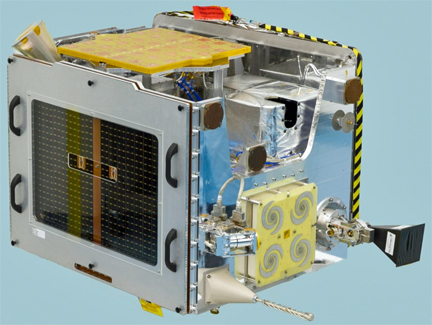
Photo of TechDemoSat-1 is courtesy of SSTL.
...Glavkosmos / NPO Lavotchkin for the launch of the U.K. technology demonstration mission, TechDemoSat-1, by the Soyuz launch vehicle from the Baikonur Cosmodrome, Kazakhstan in Q3 this year. Part-funded by the Technology Strategy Board and South East England Development Board (SEEDA), TechDemoSat-1 is a collaborative project to bolster the U.K.’s space industry by providing a low-cost opportunity for innovative commercial and research payloads under development in the UK to gain flight heritage.
Upon successful completion of the launch and early operations (LEOP) campaign, mission operations will be handed over to the new Satellite Applications Catapult Centre Harwell, Oxfordshire. It will be the first U.K. satellite to be operated from this new facility, which is currently part of the International Space Innovation Centre (ISIC) to merge with the Catapult in April of this year.
TechDemoSat-1 is based on the SSTL-150 heritage satellite platform, but has been modified to carry its cargo of eight experimental payloads, and also test some new SSTL subsystem designs. The payloads onboard the satellite include:
- SSTL’s Sea State Payload (SSP) that will demonstrate how GPS signals reflected off the ocean’s surface can be used to determine ocean roughness and help maritime shipping plan more efficient routes.
- MuREM, a miniature radiation environment and effects monitor, supplied by the Surrey Space Centre.
- The Charged Particle Spectrometer (ChaPS), a radiation detector that can perform simultaneous electron-ion detection, developed by the Mullard Space Science Laboratory (MSSL)
- The Highly Miniaturised Radiation Monitor (HMRM) from Rutherford Appleton Laboratory and Imperial College
- The Langton Ultimate Cosmic ray Intensity Detector (LUCID), a detector that can characterise the energy, type, intensity and directionality of high energy particles, developed by the Langton Star Centre, part of a sixth form college, and is an element of a broader outreach activity supported by the industrial partners.
- A Compact Modular Sounder (CMS) system, an infrared remote sensing radiometer unit, provided by Oxford University’s Planetary Group and Rutherford Appleton Laboratory
- SSBV’s CubeSAT ACS payload, which will provide 3-axes attitude determination and control
- The Cranfield de-orbit sail designed by Cranfield University, will be the last payload to be operated on TechDemoSat-1 and will move the satellite to burn up quickly in the Earth’s atmosphere at the end of its life.