

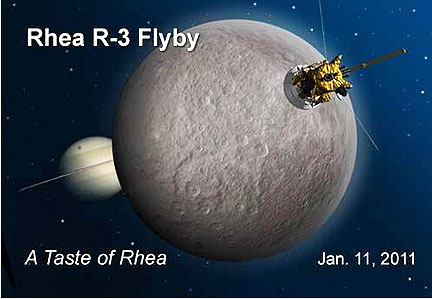
 But that's what NASA's Cassini spacecraft plans to do on its next flyby of Rhea. At closest approach, Cassini will pass within about 69 kilometers (43 miles) of the surface at 4:53 AM UTC on Tuesday, January 11, which is 10:53 PM Pacific Time on Monday, Jan. 10. This flyby is the closest Cassini will get to the icy moon's surface. Rhea, Saturn's second largest moon, is the best available chance for studying how often tiny meteoroids bombard a surface. Rhea has almost no atmosphere, which allows Cassini's cosmic dust analyzer and radio and plasma wave instrument to detect the dusty debris that flies off the surface from tiny meteoroid bombardments. Counting these dust particles ejected from Rhea's surface helps scientists estimate the bombardment rate for the Saturn system and how often the icy rings have been polluted by particles from other places in the solar system. Understanding the contamination rate will enable scientists to improve estimates of the age of the rings.
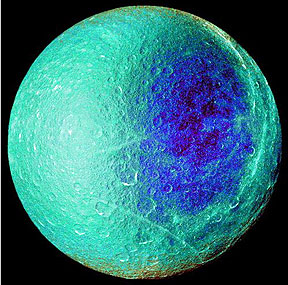
Hemispheric color differences on Saturn's moon Rhea are apparent in this false-color view from NASA's Cassini spacecraft. This image shows the side of the moon that always faces the planet.
Hemispheric color differences on Saturn's moon Rhea are apparent in this false-color view from NASA's Cassini spacecraft. This image shows the side of the moon that always faces the planet. The upcoming flyby will also enable scientists to gather more data on Rhea’s very thin oxygen-and-carbon-dioxide atmosphere that was recently discovered by Cassini scientists using the ion and neutral mass spectrometer and the Cassini plasma spectrometer. Fields and particles instruments will also investigate the interaction between Rhea and the magnetic bubble around Saturn known as the magnetosphere.
Cassini will also snap pictures of the Rhea surface, a venture that will include making a global mosaic of such regions as the large Tirawa basin and the dark bluish spots around Rhea's equator. The imaging cameras will also take another look to see if there is any more evidence of a ring around Rhea. This is the third close flyby of Saturn's moon Rhea. The closest flyby before this one was 100 kilometers (60 miles) in altitude.