

Bright moonlight streams through your window. A nugget of space debris disintegrates in a sparkling fireball. A huge spaceship glides silently overhead. By itself, any one of these events might be enough to get you out of bed. This weekend, all three are going to happen at the same time.
On August 12th and 13th, as the Moon waxes full, the International Space Station will glide over U.S. towns and cities during the peak of the annual Perseid meteor shower. The meteor shower is already underway. Earth is passing through a broad stream of debris from Comet Swift-Tuttle, and specks of comet dust are hitting the top of Earth's atmosphere at 140,000 mph. These disintegrating meteors stream out of the constellation Perseus—hence the name "Perseids." According to the International Meteor Organization, worldwide observers now are counting more than a dozen Perseids per hour with more to come on August 12-13 when Earth passes near the heart of the debris stream.
Experts note that moonlight and meteor showers don't mix. Indeed, the great number of faint Perseids that observers would normally count in a dark year will be invisible in 2011 with the Moon glaring overhead. On the bright side—no pun intended—any Perseid that does manage to pierce the glare is likely to be a fireball. These are caused by relatively big pieces of debris disintegrating in flashes too bright to be subdued. It's not unusual to see at least a few Perseid shadow-casters on peak night. Perseid meteors can appear any time Perseus is above the horizon, i.e., between about 10:00 p.m. and sunrise. The best time to look is during the hours before dawn especially on Saturday morning, August 13th. The full Moon will be relatively low, and the meteor rate should be peaking at that time.
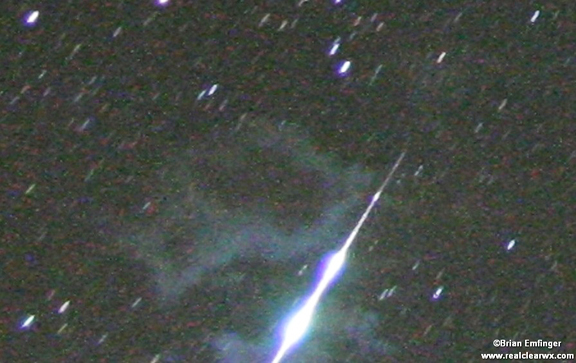
Brian Emfinger of Ozark, Arkansas, photographed this early Perseid just after midnight on Sunday, July 26, 2009. Photo courtesy of NASA Science News.