

[SatNews] In the near future, satellites will be able to acquire almost limitless amounts of data—however, the amount of data made available to the end user will always be determined by a number of factors including how quickly that data can be downlinked from the satellite to Earth.
A typical pass of a low Earth orbit satellite over a ground station is just 10 to 11 minutes, and all of the required data must be downlinked within this time. Small satellites are able to image in higher and higher resolution; in the last 10 years, SSTL small satellites have gone from a default resolution of 32m (with DMC satellites like NigeriaSat-1) to capable of sub 1m resolution imaging (with the DMC3 constellation). This, along with other platform improvements, has resulted in a huge increase in the image throughput capability and amount of imagery generated. Subsequently, the speed of data transfer between the satellite and ground station must increase.
The gain (amplification) of a satellite’s antenna has a significant effect on the quality and strength of the signals that can be transmitted, and, therefore, the bandwidth and data rate. Lengthening the antenna increases it’s gain and increasing the horn size on the antenna concentrates the signal, both allowing a higher bandwidth link to the ground station for faster data transfer.
Using composite materials meant that SSTL could create a higher capability subsystem that is still compatible with existing satellite platforms and systems. The detailed horn antenna is typically used onboard an Antenna Pointing Mechanism, which is used to maintain the line of sight with the ground station during a pass even allowing for a satellite that changes its orientation during the pass. Through restricting the mass of the horn antenna assembly via carbon fibre materials, in turn the core backbone components of the Antenna Pointing Mechanism did not need to be changed to incorporate the larger sized antenna, such as the motor, transmission and bearings. This approach keeps costs down and allows SSTL to incrementally improve the capability of its satellites, instead of having to redesign entire platforms every time.
In 2000, SSTL satellites downlinked at 38.4Kbps—roughly the same as an old dial-up modem. Dial-up is a thing of the past these days. NigeriaSat-2, which was SSTL’s highest performance Earth observation satellite when launched in 2011, had two antennas, each offering 105Mbps data rate. The new carbon fibre antennas can support data rates up to 500Mbps and represent a significant step change in downlink speed since 2011.

Lightweight carbon fibre antenna boosts payload data downlink speed.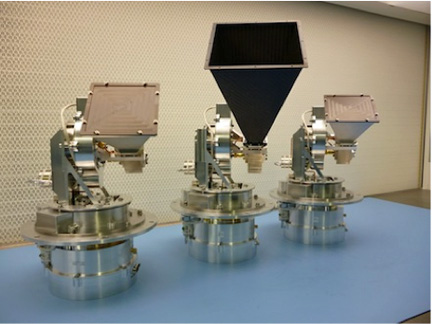
The use of carbon fibre allows a much bigger horn size for comparable mass.
Photo courtesy of SSTL.
Carbon fibre antenna on TechDemoSat-1.
Photo courtesy of SSTL.
Satnews Daily
June 4th, 2013
SSTL... A Most Effective Carbon Fibre Diet (Satellites)