

This is also designated as ChinaSat-10, Sinosat-5 or Xinnuo-5 and it is a domestic communications satellite. The launch is scheduled for Monday (16:05-16:30 UTC) from the Xi Chang Satellite Launch Center, in Sichuan Province. The launch will be conducted by China’s Long March 3B (CZ-3B/E Chang Zheng-3B/E) launch vehicle. The new satellite, which will be positioned at 110.5 degrees East, was manufactured by the China Great Wall Industry Corporation (CGWIC) after being ordered in 2006. The launch was announced well in advance by the Chinese media, given the mission is civilian, unlike most of the Chinese launches. The spacecraft is based on the DFH-4 platform, with a launch mass of 5,100 kg and will be operated by the China Direct Broadcast Satellite Co., Ltd (CHINA DBSAT). It will replace the ZhongXing-5B (Xinnuo-1, Chinasat-5B) satellite, which was launched on July 18, 1998.
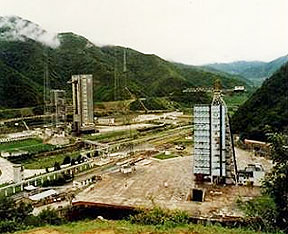
The Xi Chang Satellite Launch Center
Based on the CZ-3A Chang Zheng-3A, the CZ-3B Chang Zheng-3B is the most powerful launch vehicle in the Chinese space launch fleet. The CZ-3B features enlarged launch propellant tanks, improved computer systems, a larger 4.2 meter diameter payload fairing and the addition of four strap-on boosters in the core stage, which provide additional power during the first stage of flight. The rocket is capable of launching a 11,200 kg satellite to a Low Earth Orbit or a 5,100 kg cargo to a Geosynchronous Transfer Orbit. The rocket has a total length of 54.84 meters and a core diameter of 3.35 meters.