

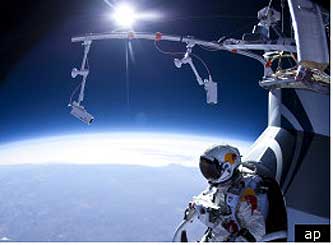
The pod.
Felix Baumgartner self described as a skydiving daredevil completed the halfway mark of his ultimate goal of setting a world record for the highest jump. Baumgartner has jumped 2,500 times from planes and helicopters, as well as some of the highest landmarks and skyscrapers on the planet. However, he wants to drop from 90,000 feet before attempting the full 120,000 feet to break the 1960 record of Joe Kittinger, a retired Air Force officer from Florida who jumped from 102,800 feet, or 19.5 miles. It is pointed out that jets cruise at 30,000 feet.
So how did Baumgartner accomplish his goal yesterday at Roswell, New Mexico?
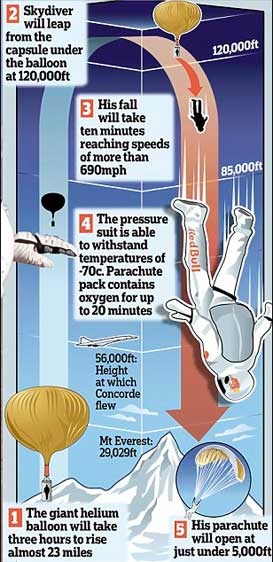
He was lifted high by a 100 foot long helium balloon, while inside a custom pressurized capsule that took Felix to 71,581 feet, or translated, 13.6 miles. He reached speeds of up to 364.4 mph and was in free fall for three minutes and 43 seconds, before pulling his parachute cords, according to his spokesperson Trish Medalen. Later this summer he will go for a height of 23 miles. The jump yesterday was also a test run of his capsule, parachutes, and customized full-pressure suit, and all performed perfectly. The project is dubbed Red Bull Stratos (referring to the stratosphere). The energy drink is his sponsor and picking up what must be a hefty tab for this one-of-a-kind stunt.
Baumgartner himself almost scrapped the event when the idea of staying inside the spacesuit's claustrophobic confines for the balloon's five-hour ascent caused him anxiety. But with that hurdle cleared by psychological training, the remaining deadly threats are glitches in the suit or a chute-tangling spin.
"The first minute of his jump is key, because if he doesn't spin and the suit is intact, physiologically Felix is in the clear," says Jim Bagian, one of many aerospace veterans on the Stratos team. The former space shuttle astronaut investigated the Challenger and Columbia disasters.
"With pressurized suits, you can survive a bailout from extreme heights," he says. "This project is no stunt. What we're learning here can have big applications." Bagian says the suit that was made by the David Clark Co., creators of NASA's astronaut gear is a mix of polyester, Gore-Tex and flame-resistant Nomex, laced with bladders that keep the body pressurized in space.
But he adds that the real magic is less in the material and more in creating a durable suit that is form-fitting enough for a free-falling human to maintain body control.
Another of Baumgartner's key advisers knows just how crucial that is. In 1960, Air Force Col. Joe Kittinger, now 83, dived out of a high-altitude balloon in his bulky suit, passed out after going into a propeller-like flat spin, and awoke hanging from his parachute straps.
Baumgartner's chief advisers include a former NASA flight director who now directs the medical team: Dr. Jonathan Clark, whose astronaut wife, Laurel, was killed aboard space shuttle Columbia in 2003. Because of the accident Clark is determined to become an expert in spacecraft emergency escape...and now they're halfway there.