

...charge-coupled device (CCD) cameras and simulators as part of a future Earth Observation (EO) satellite called Ionospheric Connection Explorer (ICON) that will study the variability of Earth's ionosphere, which can interfere with communications and geopositioning signals. Officials of the Naval Research Laboratory at Stennis Space Center outside of Gulfport, Mississippi, released a presolicitation notice (N00173-13-R-SE02) on Monday for the Research and Development for Engineering Models (EM) and spaceflight qualified Flight Model (FM) Charge-Coupled Device (CCD) Cameras for the Michelson Interferometer for Global High-resolution Thermospheric Imager (MIGHTI) program. The project calls for NRL researchers to purchase CCD cameras and simulators from the aerospace industry for the MIGHTI sensor that will be part of the ICON satellite, which is under development at the University of California, Berkeley.
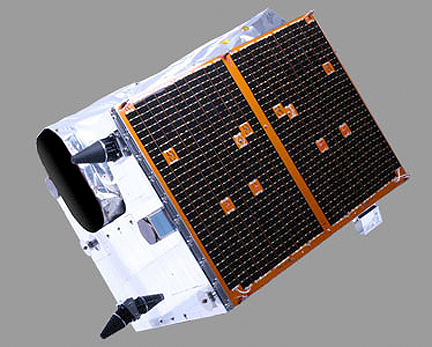
Packing a CCD-based imaging system is the RapidEye satellite constellation for EO. Image courtesy of RapidEye.
NRL officials will hire a company to build two flight model CCD cameras, one for each of the two MIGHTI units; one engineering model CCD camera, two electrically/electronically accurate camera simulators for power, command, control, and data interface testing; and one set of critical components for a third spare CCD camera. NRL also will need one additional simulator, engineering-model and flight-model CCD camera and assembly of a third flight-model CCD camera using the set of critical long-lead time components provided in the base award.
Each CCD camera will have a cooled CCD, an NRL-supplied spectral filter immediately in front of the CCD, front-end electronics including A/D converter, radiation shield, mechanical enclosure, and interfaces. For questions or concerns, contact the Navy's Eric Sogard by phone at 228-688-5980 or by email at [email protected], or Carol Parnell by phone at 202-767-2372 or by email at [email protected].