

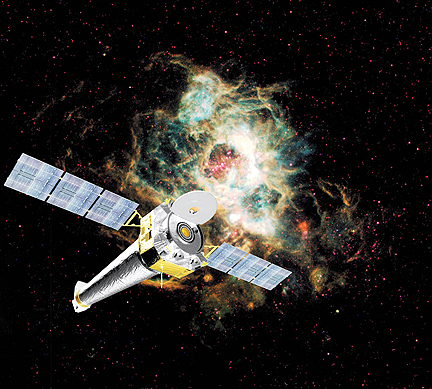
Chandra X-ray Laboratory, artistic rendition
"If our interpretation is correct, this is the nearest example where the birth of a black hole has been observed," said Daniel Patnaude of the Harvard-Smithsonian Center for Astrophysics in Cambridge, Mass. who led the study. The scientists think SN 1979C, first discovered by an amateur astronomer in 1979, formed when a star about 20 times more massive than the sun collapsed. Many new black holes in the distant universe previously have been detected in the form of gamma-ray bursts (GRBs).
However, SN 1979C is different as it is much closer and belongs to a class of supernovas unlikely to be associated with a GRB. Theory predicts most black holes in the universe should form when the core of a star collapses and a GRB is not produced. "This may be the first time the common way of making a black hole has been observed," said co-author Abraham Loeb, also of the Harvard-Smithsonian Center for Astrophysics. "However, it is very difficult to detect this type of black hole birth because decades of X-ray observations are needed to make the case." The idea of a black hole with an observed age of only about 30 years is consistent with recent theoretical work. In 2005, a theory was presented that the bright optical light of this supernova was powered by a jet from a black hole that was unable to penetrate the hydrogen envelope of the star to form a GRB. The results seen in the observations of SN 1979C fit this theory very well.
Although the evidence points to a newly formed black hole in SN 1979C, another intriguing possibility is that a young, rapidly spinning neutron star with a powerful wind of high energy particles could be responsible for the X-ray emission. This would make the object in SN 1979C the youngest and brightest example of such a "pulsar wind nebula" and the youngest known neutron star. The Crab pulsar, the best-known example of a bright pulsar wind nebula, is about 950 years old.