

Ministers from ESA’s 20 member states and Canada have allocated 10 billion euros for ESA’s space activities and programmes for the years to come. Apart from the 20 ESA Member States and Canada, several observers were also present at the Ministerial Council: Eight out of the nine EU Member States that are not yet Member States of ESA (Bulgaria, Estonia, Hungary, Cyprus, Latvia, Lithuania, the Slovak Republic and Malta); the European Commission, the European Organisation for the Exploitation of Meteorological Satellites (EUMETSAT), the European Science Foundation, the European Defence Agency (EDA), the European Maritime Safety Agency (EMSA), the European GNSS Agency (GSA) and the Organisation for Economic Co-operation and Development (OECD).
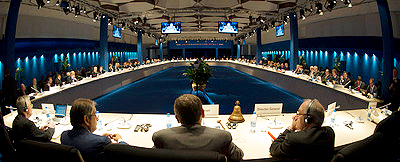
ESA Council at Ministerial Level,
Naples, 20 November 2012
Photo courtesy ESA
Ministers focused the investments on fields with high growth potential or with a direct and immediate impact on the economy such as telecommunications and meteorology. They approved ESA’s level of resources for 2013-17, the proposals for the domain of Earth Observation (EO) and confirmed Europe’s commitment to the exploitation of the International Space Station (ISS). Ministers secured investments for the detailed definition studies of the new launcher Ariane 6 and the continuation of the development of Ariane 5 ME adapted, with the goal to develop as many commonalities as possible between the two launchers. These activities are funded for two years with a decision on the continuation of both launchers to be taken in 2014.
Ministers gave the green light for Europe to provide the service module of NASA’s new Orion Multipurpose Crew Vehicle (MPCV) as an in-kind contribution for ISS operations for 2017–20. This decision is strategically important for Europe as it will enable a cooperation between ESA and NASA on the future human space transportation system.
Ministers of ESA Member States approved a Political Declaration towards the European Space Agency that best serves Europe. In doing so, Ministers have initiated a process able to define how ESA can adapt its operations to take benefit of both, its intergovernmental framework and the EU competence in space. They have also stated their willingness to ensure coordination and coherence between the process initiated on the ESA side and the one initiated on the EU side. This Political Declaration was also supported by Ministers from 7 of the EU member States not yet members of ESA present at the meeting. Ministers decided to hold the next Council at ministerial level in spring 2014.
The Ministers adopted the following four Resolutions:
- First, “On the role of ESA in sustaining competitiveness and growth” political and programmatic highlights of the Council
- Second, “Level of Resources for the Agency’s Mandatory activities 2013–2017” which cover the science programme and basic activities
- Third, the renewal of the contribution of ESA Member States to the running costs of the Guiana Space Centre, Europe’s spaceport in French Guiana
- Fourth, the “Political Declaration towards the European Space Agency that best serves Europe.”
The last Resolution initiates a process for the further evolution of ESA. The objective is to capitalise on the competences and the achievements of ESA while taking full benefit of EU policies. The process will ensure the continued success of ESA as the research and development space agency for Europe, Member States and the EU. The Resolutions will be made available on ESA’s website.
A dedicated website for the Council Meeting at Ministerial Level 2012 outlines in more detail the various proposals that were submitted to Ministers: http://www.esa.int/SPECIALS/Ministerial_Council_2012/
However, the two day meetings at Naples, Italy, were not all that fortuitous...
...for the European Space Agency (ESA)—spending cuts went into effect as requested by a number of ESA member governments afflicted by the crisis of debt. Funding has been reduced for a number of projects, resulting in an approximately two to three percent drop in expenditure approvals. ESA had requested an increase of two percent per year.
Hit by budget woes were ESA's Earth Observation program's Explorer satellites, with a 1.9 bilion euros five year requested package being reduced to 1 billion euros over four years.
Not of assistance with the financial wall was the ESA's requested increase in Metop Second Generation (Metop 2Gen) mission (for more complete information regarding the Metop decisions, see "ESA + EUMETSAT... Agreement Accord (Satellites)" story in today's news section, as well) related expenses. Due to payload roles being re-arranged by ESA, Eumetsat and NOAA, the total amount to be invested with Metop 2Gen will be 808 million euros... somewhat more than had initially been planned for expenditure on this program by the ESA—and such probably undercut support for other desired projects.
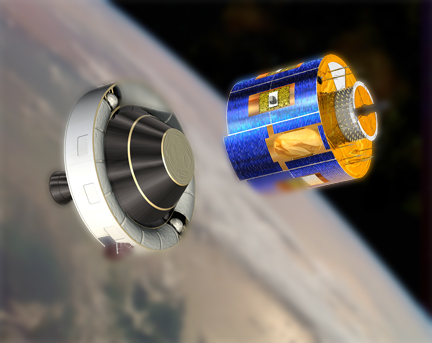
Artists impression of Meteosat Second Generation (MSG).
Credit: ESA/D. Ducros.
Also less than what had been hoped for will be the ESA's science program... during 2012, that amount was budgeted at nearly 480 million euros—well, what have we here? Seems as though 508 million euros is the amount approved.. what's wrong with that? Nothing, other than the fact that the total is for the years 2013 through 2017. If it hadn't been for new members Poland and Romania and their additional revenue contributions of around six percent, the through-2017 amount is expected to have been somewhat less.
Gone for this present funding cycle are an advanced AIS technologies surveillance system test for maritime (although a less advanced satellite budget was approved) and a mission with China that was designed to deliver space weather mission information.