

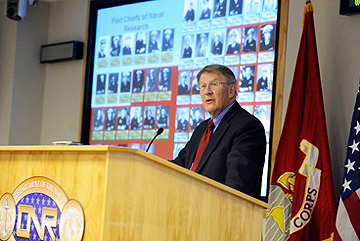
Dr. John Montgomery, Director of Research for the Naval Research Laboratory, offers remarks during the Office of Naval Research's 65th anniversary celebration honoring the commands history of science and technology (S&T) milestones. (U.S. Navy photo by John F. Williams)
Unveiling a design for an expansive timeline mural that will showcase the command's history of science and technology (S&T) milestones, the Office of Naval Research (ONR) celebrated its 65th anniversary Aug. 1 with a ceremony at its headquarters. Dr. John Montgomery, Director of Research for the Naval Research Laboratory, offers remarks during the Office of Naval Research's 65th anniversary celebration honoring the commands history of science and technology (S&T) milestones.
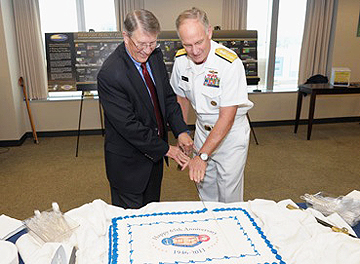
Dr. John Montgomery, NRL's Director of Research, and Rear Adm. Nevin Carr, Chief of Naval Research, cut the ONR anniversary cake. (U.S. Navy photo by John F. Williams)
At the urging of American inventor and scientist Thomas Edison, ONR began its infancy in 1923 as NRL. Now ONR's corporate lab, NRL has a history of pioneering work, which includes the first U.S. surveillance satellite, synthetic lubricants (for modern gas turbine engines), and the Global Positioning System, or GPS, which revolutionized the science of navigation. President Harry S. Truman launched ONR on Aug. 1, 1946 with the mission of "planning, fostering, and encouraging scientific research in recognition of its paramount importance as related to the maintenance of future naval power and the preservation of national security."
Today, the naval command manages the S&T portfolio for the Department of the Navy and provides technical advice to the secretary of the navy and chief of naval operations. It executes its mission by funding (through grants and contracts) engineers, physicists, mathematicians, oceanographers, meteorologists and scientists who perform basic research, technology development and advanced demonstrations. Validating its investments in science and technology, more than 50 researchers have won Nobel prizes for their ONR-funded work. In the 1940s-50s, ONR-sponsored researchers developed the first molecular beam machine, currently used by doctors in precision surgeries and procedures; laid the foundation for the Navy's deep-sea submergence program with the record-setting 35,800-foot, deep-sea dive of the research vessel Trieste; and engineered microwave amplification by stimulated emission of radiation, or maser, the precursor to the laser.
With the arrival of the 1960s, the naval S&T provider built upon its investment in undersea exploration by funding SEALAB I, II and III, creating experimental habitats to prove humans could exist underwater for extended periods of time. In 1985, ONR's sonar technology was used to detect the Titanic's wreckage at a depth of nearly 12,500 feet in the Atlantic Ocean, ushering in the age of remotely and autonomously piloted underwater vehicles.
Beyond oceanographic exploration, ONR is also focused on meeting emerging challenges. It is investing in science, technology, engineering and mathematics (STEM) education for future naval innovators; pursuing life-saving medical advances; and researching revolutionary weapons that promise to transform how naval forces fight future battles. Chief of Naval Operations Adm. Gary Roughead said the Navy and Marine Corps will always look to ONR to deliver the "next big thing" in naval technology. "Since 1946, the Office of Naval Research and the wider science and engineering community have contributed mightily to our efforts to build the future fleet by providing the technological advantage our Navy needs," Roughead said at a recent conference sponsored by ONR. "And those contributions are rather exceptional today."
