

 [SatNews] Astrium has been awarded the Payload Module contract for the European Space Agency’s (ESA) future astronomy mission Euclid, due for launch in 2020. Astrium will deliver a fully integrated module incorporating a 1.2 metre diameter silicon carbide (SiC) telescope and housing the mission’s science instruments.
Euclid is the second “Medium Class” mission in ESA’s Cosmic Vision program. With the ultimate goal to understand the origin of the Universe’s accelerating expansion, Euclid will map the geometry of the dark universe to an unprecedented accuracy. Euclid is unique in the combination of its two methods for measuring that geometry, namely weak gravitational lensing and galaxy clustering.
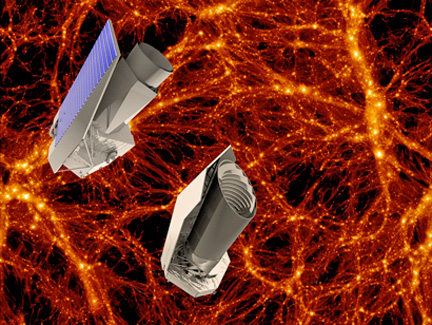
Thales Alenia Space and EADS Astrium concepts for Euclid. Image copyright: ESA
Euclid will collect deep and high resolution images of the sky by rotating the spacecraft once every 80 minutes. Within six years of observation, covering more than one-third of the entire sky, Euclid will measure the shapes of, and distances to, more than 2 billion galaxies.
The key features of the Euclid Payload Module are:
- A lightweight Silicon Carbide (SiC) telescope with an excellent thermal stability and operating at 130K (-143° Celsius), making it invisible to near infrared wavelengths
- A 1.2 meter diameter mirror permitting diffraction limited observation of galaxies as faint as magnitude 24.5
- A three-mirror Korsch telescope design supplying light to its two scientific instruments, the Visible Imager (VIS), and the Near-Infrared Spectrophotometer (NISP)
- The VIS & NISP instruments are maintained in a very cold environment at 135K (-138° Celsius). The VIS & NISP instruments are developed by the Euclid Consortium and delivered to Astrium by ESA