

The spacecraft made its closest approach to comet Tempel 1 on Monday, Feb. 14, at 8:40 p.m. PST at a distance of approximately 111 miles. Stardust took 72 high-resolution images of the comet. It also accumulated 468 kilobytes of data about the dust in its coma, the cloud that is a comet's atmosphere. The craft is on its second mission of exploration called Stardust-NExT, having completed its prime mission collecting cometary particles and returning them to Earth in 2006. The Stardust-NExT mission met its goals, which included observing surface features that changed in areas previously seen during the 2005 Deep Impact mission; imaging new terrain; and viewing the crater generated when the 2005 mission propelled an impactor at the comet. Several of the images provide tantalizing clues to the result of the Deep Impact mission's collision with Tempel 1.
"We see a crater with a small mound in the center, and it appears that some of the ejecta went up and came right back down," said Pete Schultz of Brown University, Providence, R.I. "This tells us this cometary nucleus is fragile and weak based on how subdued the crater is we see today." Engineering telemetry downlinked after closest approach indicates the spacecraft flew through waves of disintegrating cometary particles, including a dozen impacts that penetrated more than one layer of its protective shielding.
"The data indicate Stardust went through something similar to a B-17 bomber flying through flak in World War II," said Don Brownlee, Stardust-NExT co-investigator from the University of Washington in Seattle. "Instead of having a little stream of uniform particles coming out, they apparently came out in chunks and crumbled." While the Valentine's Day night encounter of Tempel 1 is complete, the spacecraft will continue to look at its latest cometary obsession from afar. Stardust-NExT is a low-cost mission that is expanding the investigation of comet Tempel 1 initiated by the Deep Impact spacecraft. The mission is managed by JPL for NASA's Science Mission Directorate in Washington. Lockheed Martin Space Systems in Denver built the spacecraft and manages day-to-day mission operations.
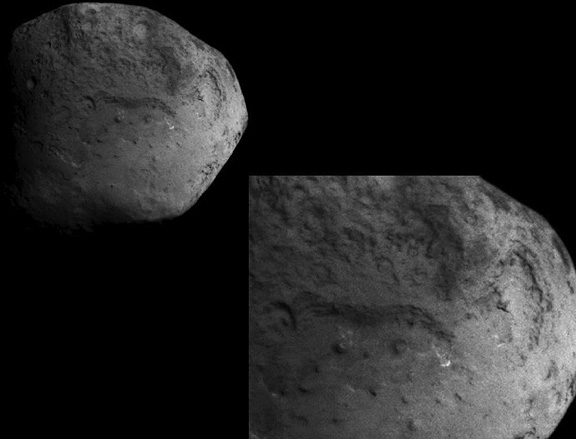
This image obtained by NASA's Stardust spacecraft shows a side of the nucleus of comet Tempel 1 that has never been seen before. In the image, three terraces of different elevations are visible, with dark, banded scarps, or slopes, separating them. The widest of the banded slopes is about 2 kilometers (1 mile). The lowest terrace has two circular features that are about 150 meters (500 feet) in diameter. An inset on the right shows a closer view. This image was taken on February 14, 2011, at 8:39:21 p.m. PST. The spatial resolution is about 15 meters (50 feet) per pixel. NASA's Deep Impact spacecraft visited this same comet in July 2005 and also observed the presence of layers on the other side of the comet. This image shows at least 90 percent new territory.