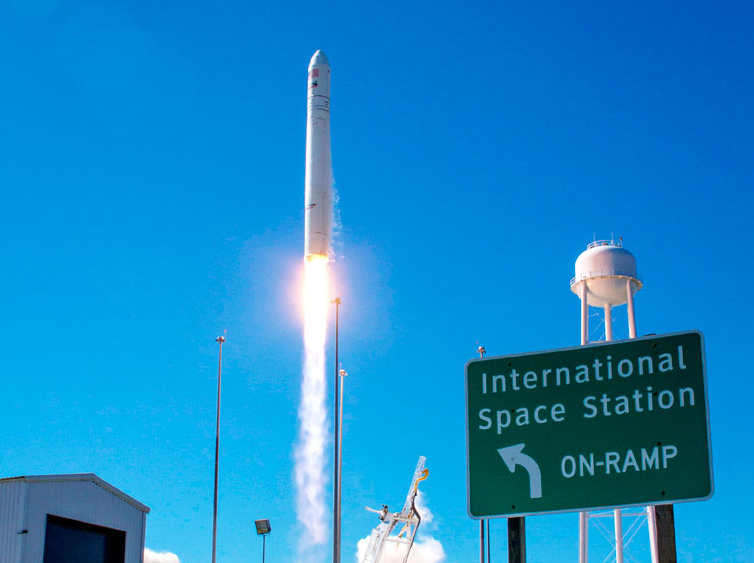
Launch of Wednesday, September 18 from Wallops Flight Facility
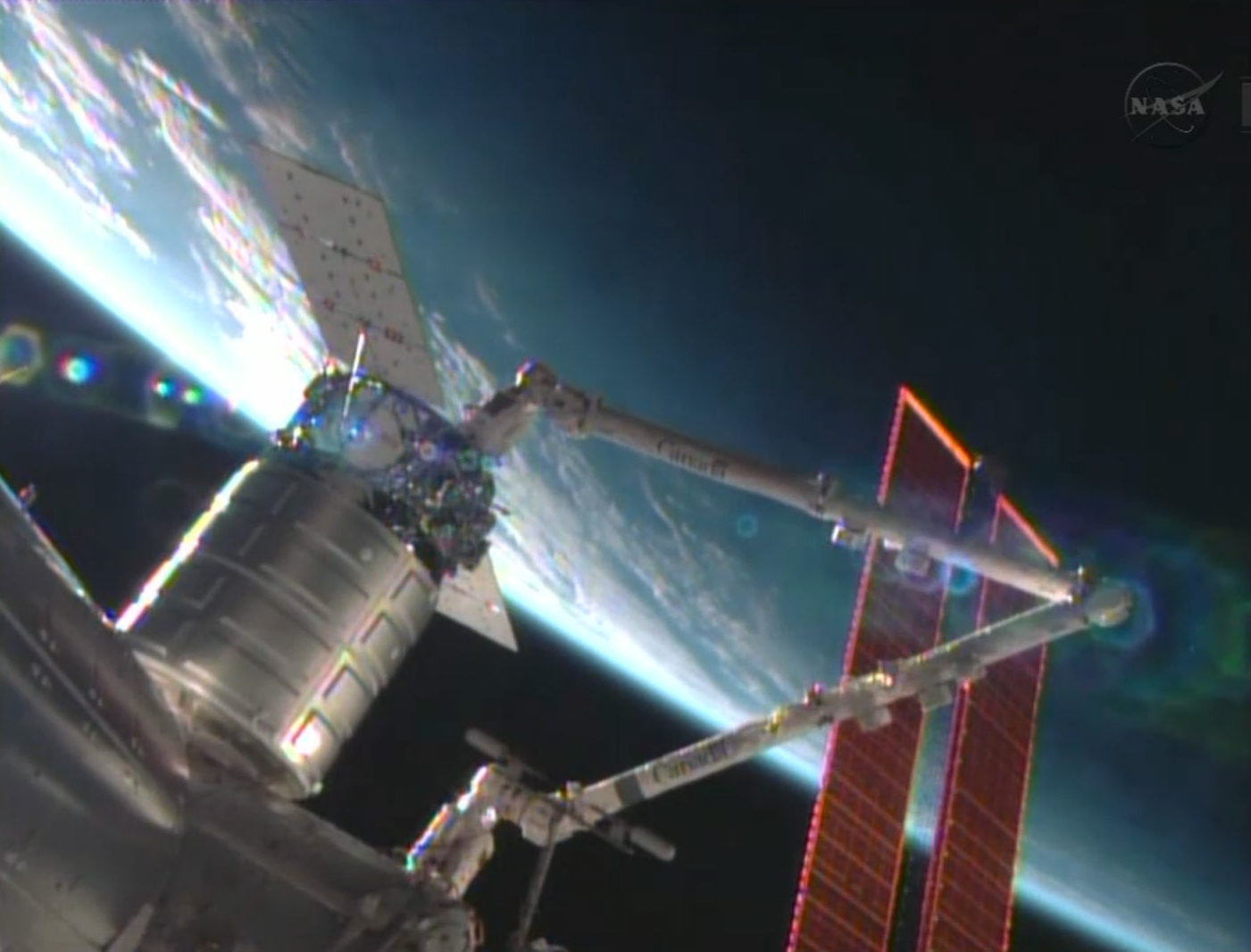
As Cygnus met its demonstration objectives and moved closer to the space station, Expedition 37 Flight Engineers Luca Parmitano and Karen Nyberg watched and worked in tandem with Mission Control. Parmitano was in the cupola at the Canadarm2 controls monitoring its approach. Nyberg was his back up at the secondary robotics workstation inside the Destiny laboratory.
When Cygnus met its final demonstration objective of pointing a tracking laser at a reflector on the Kibo laboratory it moved to its capture point about 10 meters from the station. Cygnus turned off its thrusters, operated in free drift, and Parmitano maneuvered the Canadarm2 to grapple and capture Cygnus.
“This entire COTS demonstration mission has been executed in textbook fashion by the joint NASA and Orbital teams, from Antares’ launch 10 days ago to Cygnus’ berthing at the station this morning,” said Mr. David W. Thompson, Orbital’s President and Chief Executive Officer. “A tremendous amount of hard work has gone into this five-year effort from our launch vehicle and spacecraft teams, and we are all exceptionally proud of their accomplishments. We look forward to moving ahead with regularly scheduled ISS cargo delivery missions for NASA as early as the end of the year.”
Orbital and NASA cooperatively developed the Cygnus cargo spacecraft under the Commercial Orbital Transportation Services (COTS) program that started in 2008. For the COTS demonstration mission, Cygnus carried a relatively light load of cargo to the ISS. The ISS crew will start unpacking the 700 kg of cargo and supplies tomorrow, which includes food, clothing and experimental equipment. In early October, they will begin filling the cargo module with up to 800 kg of disposal cargo prior to its departure. For future missions, Cygnus has a total cargo up-mass capacity of 2,000 kg in its standard configuration, expanding to 2,700 kg in its enhanced design for later missions. This first Cygnus will remain at the ISS for 30 days before departing for a destructive reentry over the Pacific Ocean in late October.
Following the successful completion of the COTS demonstration mission, Orbital will begin to carry out operational missions under the $1.9 billion Commercial Resupply Services (CRS) contract with NASA. The company will deliver approximately 20,000 kg of cargo to the ISS on eight more Antares/Cygnus missions through 2016. Each Cygnus cargo ship will carry crew food, clothing and other supplies; spare parts and equipment; and scientific experiments to the space station.
Orbital Sciences is the second company to send a commercial cargo craft to the space station. SpaceX was the first company to send its own cargo ship with two successful commercial resupply missions and two demonstration missions under its belt.
Orbital developed the Cygnus cargo spacecraft as part of its COTS joint research and development initiative with NASA. Cygnus consists of a common Service Module (SM) and a Pressurized Cargo Module (PCM). The SM incorporates avionics, power, propulsion and communications systems already successfully flown aboard dozens of Orbital’s LEOStar™ and GEOStar™ satellites. The PCM, designed and built by Thales Alenia Space under a subcontract from Orbital, is based on the Multi-Purpose Logistics Module (MPLM) previously used with the Space Shuttle. With a full load of cargo and fuel, the standard-configuration Cygnus weighs about 5,200 kg at launch and generates 3.5 kw of electrical power while in orbit. It is capable of extended-duration missions of a year or longer in space.
Topical Tags :
Regional Tags :