

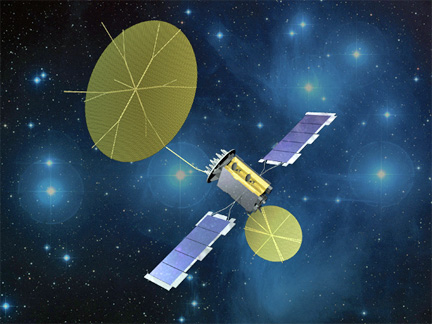
Artistic rendition of MUOS, courtesy of Lockheed Martin Corp.
The MUOS constellation replaces the legacy Ultra High Frequency (UHF) Follow-On system and delivers secure, prioritized voice and data communications, a first for mobile users who need high-speed mission data on the go. The first MUOS satellite, launched in 2012, has been providing high quality legacy voice communications for users, and terminals are already testing using the advanced payload that enables data exchanges.
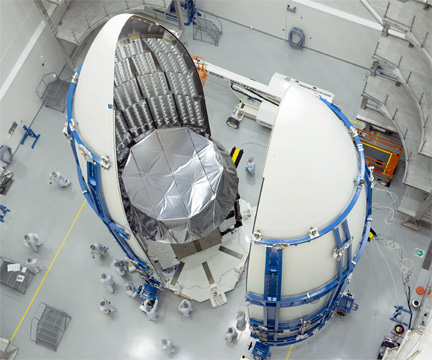
The encapsulation of MUOS #2,
photo courtesy of Lockheed Martin Corp.
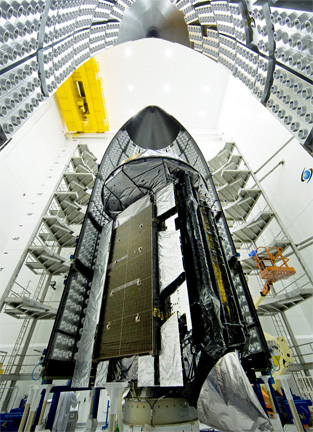
The second satellite of the Mobile User Objective System constellation will launch in July from Cape Canaveral Air Force Station, Fla. Four satellites and one on-orbit spare will comprise the constellation, which will provide service worldwide.
Photo courtesy of Lockheed Martin Corp.
The geosynchronous constellation consists of four satellites and one on-orbit spare, which are expected to achieve full operational capability in 2015, extending UHF narrowband communications availability well past 2025.
Lockheed Martin Space Systems, Sunnyvale, Calif., is the MUOS prime contractor and system integrator. The Navy's Program Executive Office for Space Systems, Chantilly, Virginia, and its Communications Satellite Program Office, San Diego, California, are responsible for the MUOS program.