[SatNews] This Company is continuing its support of the world-renowned survey that is identifying archaeological sites in Genghis Khan’s homeland – Mongolia’s most sacred heritage area.
During the expedition’s second phase, completed last summer, Stratos supplied Inmarsat BGAN mobile satellite communications service to researchers as they used digital imagery to search for archaeological sites in the remote valley of the ancient Mongolian empire. Stratos equipment supplier ViaSat also continued its support by donating its VRT-100 rugged BGAN terminal for this project. The Valley of the Khans (VOTK) research project, supported by the joint National Geographic Society/Waitt Grants Program, is led by University of California San Diego research associate Albert Yu-Min Lin, Ph.D. Dr. Lin initiated this project in 2009 using a new, non-invasive scientific approach. The project is performing a non-destructive archaeological search, using modern digital tools from a variety of disciplines, including digital imagery, computer vision, non-destructive surveying, and on-site digital archaeology.
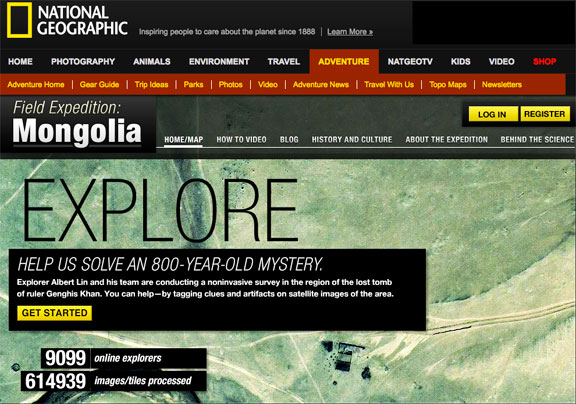
The 2010 VOTK expedition, using twice as many professionals as the 2009 inaugural search, was expanded to include a search area of 3,000 kilometers. This expansion was made possible by using satellite imaging and an innovative Human Computation toolkit. BGAN from Stratos made it possible for the 2010 VOTK expedition to deploy the Human Computation toolkit. Before entering a new region, the team would use its BGAN connection to enable members of the general public to serve as “virtual explorers” online to help search through and tag GeoEye-1 satellite imagery of the region in which the team was operating. Each morning, the team would again use its BGAN connection to download annotations provided by virtual explorers – then use those annotations to direct its ground search. This application enabled the team to significantly increase its search area and deploy a multi-stage approach to discovery, including: satellite imagery; aerial imagery; and geomagnetic surveys such as ground-penetrating radar and electro-magnetometers.
“The expansion of our expedition would have been impossible without BGAN from Stratos,” said Dr. Lin. “BGAN provided us with reliable voice and data connectivity in one of the world’s most remote regions. This helped us maintain the highest levels of safety and productivity while in the field. In addition to the human computation toolkit, we used BGAN for photo transmission, blogging and to secure critical medical consultations from the field.”
The research team now is analyzing its field data and expects to announce its results by the end of this year. The VOTK search seeks to locate archaeological sites from the period of Genghis Khan without disturbing them, thus shedding light on Mongolia’s rich historical heritage and enabling conservation and education in this rapidly changing landscape. The search maintains respect for local customs while enabling protective measures through organizations such as UNESCO. The VOTK research project was one of National Geographic Adventure magazine’s 2010 Adventures of the Year.