NASA... Science Success With Global Hawk...
NASA has announced the successful completion of the first science flight to be performed by a large, unmanned aerial vehicle (UAV). Using one of its two
Global Hawk aircraft, scientists at
NASA managed to conduct the first long-duration, high-altitude flight above the Pacific Ocean, collecting a wealth of scientific data in the process.
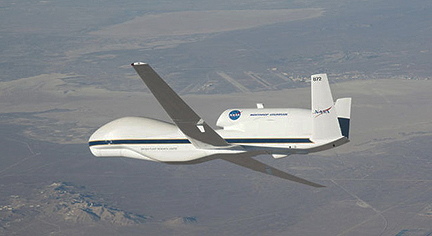
The Global Hawk can fly autonomously to altitudes above 60,000 feet, for about 30 straight hours. Photo credit: NASA / Dryden / Carla Thomas
Generally, Global Hawks are used for reconnaissance and monitoring missions by the military, and this is the first instance in which it was converted to civilian applications. Throughout April, the
Global Hawk Pacific (
GloPac) mission was scheduled to perform five flights. With the successful completion of the first one, four others remain, but the program will most likely extend in the future as well. The goal of the initiative is to study traits related to Earth's atmosphere, and to the interactions of its components, above the Pacific and Arctic oceans, experts at the NASA
Jet Propulsion Laboratory (JPL) in Pasadena, California, report on their official website.
The first science flight took place last Wednesday and lasted for about 14 hours. The Global Hawk UAV flew for about 8,334 kilometers (4,500 nautical miles) non-stop, collecting readings with the vast array of instruments it has on board. During the flight, it reached an altitude of 18,562 meters (60,900 feet), which is about twice as high than commercial airliners. The flight was controlled from the
NASA Dryden Flight Research Center, in the Mojave Desert, California.
Topical Tags :
Regional Tags :

