

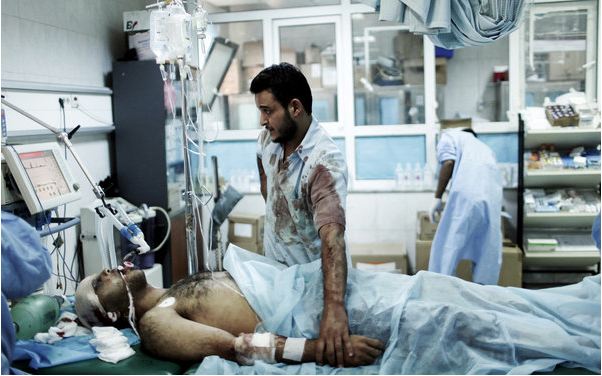
A man stood over a relative who had been shot by a pro-Qaddafi sniper in Tripoli on Thursday. Photo by Moises Saman for The New York Times
Télécoms Sans Frontières (TSF) is providing essential support for victims of the conflict in Libya, using mobile satellite services to help hospitals and refugees.
The Inmarsat-sponsored emergency communications aid agency has just installed a BGAN connection at the hospital in Jadu, western Libya. "Jadu is the most important hospital in the western region, receiving numerous injured civilians from Tripoli," said TSF's Myriam Annette.
"We were asked to implement a broadband connection to optimize the exchange of crucial information." Part of a United Nations Emergency Telecoms Cluster, TSF has also provided a BGAN connection in Nalut.

Myriam explained: "By installing reliable and fast Internet and telephone connections in western Libya, we are reinforcing the capacities of the hospitals and the Libyan Red Crescent."
TSF is now deployed in both Jadu and Yafran in western Libya. Depending on the needs assessed throughout the telecoms cluster, it is ready to connect other towns and hospitals along the western route to Tripoli.
The aid agency has also provided an IsatPhone Pro handheld for the co-ordinator of the European Commission's Humanitarian Aid Office (ECHO) and also for the president of the Libyan Red Crescent, who is also director of the Nalut hospital.
TSF first deployed to the Libyan border six months ago — initially to help the humanitarian organizations on the ground and to provide free calls for thousands of refugees at a camp in La Chucha, southern Tunisia.
Then, in April, a TSF team went to provide support in Benghazi, east of Tripoli, before moving on to Misrata in the north-west in June.
TSF mobile satellite services has continued to support further humanitarian calling and helped medical teams working on the front line. TSF is using mobile satellite airtime and equipment provided by Inmarsat distribution partner Vizada.