SES WORLD SKIES... Full Of CHIRPiness (SATCOM)
[SatNews] A new sensor has been delivered for a now-being-manufactured communications satellite.
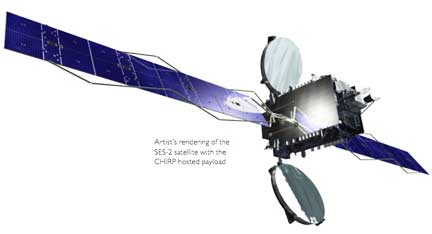
SES-2 satellite, artistic rendition courtesy of Orbital Sciences
, has delivered the
Commercially Hosted Infrared Payload (CHIRP) sensor assembly to Dulles, VA-based satellite manufacturer,
Orbital Sciences Corporation (NYSE: ORB). The sensor will be installed on
SES-2, an SES WORLD SKIES communications satellite currently in production. The arrival of the sensor developed by
Science Applications International Corporation (
SAIC) represents an important milestone for
Air Force Space and Missile Systems Center (
SMC) in their objective to test the potential of wide field-of-view, staring infrared sensors for a range of
Overhead Persistent Infrared (
OPIR) missions. Prior to shipment, the sensor completed a calibration campaign at the
Utah State University Space Dynamics Laboratory (
SDL) in Logan, UT. Major
Craig Phillips, CHIRP Program Manager at SMC, stated, “We are excited about the measured sensitivity of the instrument at SDL. Wide field-of-view sensors improve detection and collection by continuously staring over a wide area of interest which is key for meeting future OPIR requirements. Furthermore, wide field-of-view staring sensors eliminate the need for mechanical gimbals, thereby simplifying spacecraft installation and mission management.”
The next step for the CHIRP sensor will be a series of electrical interface tests.
Brent Armand, Program Manager at Orbital explained, “We will test the CHIRP sensor with a set of electronics known as the Secondary Payload Interface (SPI). The SPI is a key enabler for hosting military payloads because it provides a secure, two-way communication channel to the government payload through a standard commercial telecommunication transponder. After checking the electrical interfaces, Orbital and SAIC technicians will mount the sensor to the earth-facing panel of the satellite for full-up spacecraft mechanical and thermal testing.”
Topical Tags :
Regional Tags :