

Astronomers have pushed the NASA/ESA Hubble Space Telescope to its limits by finding what is plausibly the most distant and ancient object in the Universe ever seen. Its light has travelled for 13.2 billion years to reach Hubble, which corresponds to a redshift around 10. The age of the Universe is 13.7 billion years. The dim object, called UDFj-39546284, is likely to be a compact galaxy of blue stars that existed 480 million years after the Big Bang, only four percent of the Universe’s current age. It is tiny. Over one hundred such mini-galaxies would be needed to make up our own galaxy, the Milky Way.
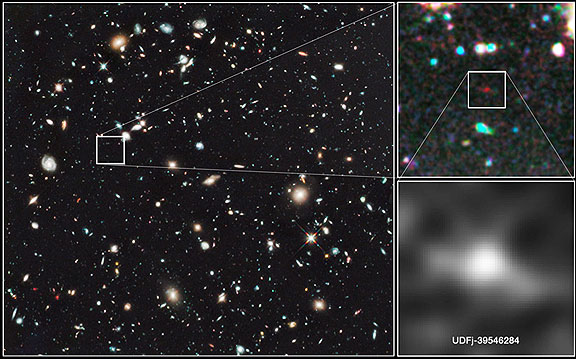
Image credit: NASA, ESA, G. Illingworth (University of California, Santa Cruz), R. Bouwens (University of California, Santa Cruz, and Leiden University) and the HUDF09 Team
This galaxy would be more distant than the population of redshift 8 galaxies recently discovered in the Hubble Ultra Deep Field, including the current most distant spectroscopically confirmed record holder at a redshift of 8.6 (eso1041), and the redshift 8.2 gamma-ray burst from 2009 (eso0917). A redshift of z = 8.6 means that the object is seen as it was around 600 million years after the Big Bang. “We’re seeing huge changes in the rate of star birth that tell us that if we go a little further back in time we’re going to see even more dramatic changes,” says Garth Illingworth of the University of California at Santa Cruz.
The astronomers were surprised, as this new result suggests that the rate at which galaxies were forming stars grew precipitously, increasing by a factor of ten over the 170 million years that elapsed between the era of this newly discovered candidate galaxy and that of the population of previously identified galaxies at a redshift around 8 (650 million years after the Big Bang). Astronomers don’t know exactly when the first stars appeared in the Universe, but every step further from Earth takes them deeper into the early Universe’s formative years when stars and galaxies were just beginning to emerge in the aftermath of the Big Bang.