

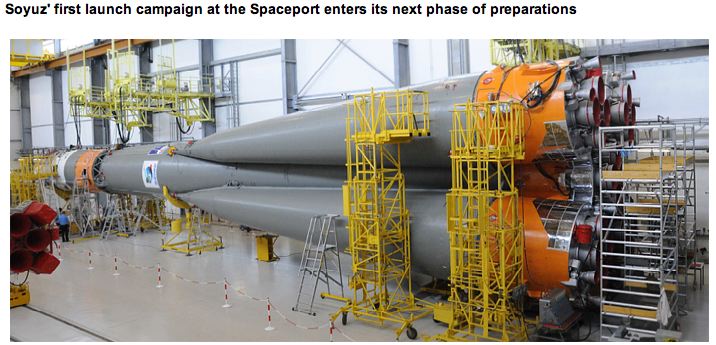
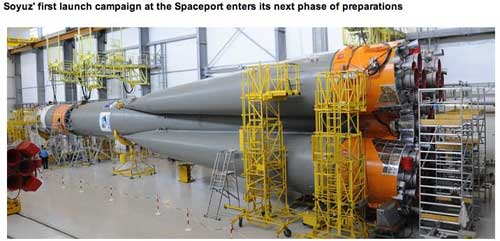
The basic three-stage Soyuz vehicle is undergoing final testing and checkout in preparation for its rollout to the Spaceport’s ELS launch pad.
Activities are in full swing across the Spaceport as its launch campaign for Soyuz’ maiden flight from French Guiana moves ahead for the historic liftoff on October 20.
“We’re right on the timeline, and everything is proceeding well from all aspects,” said Jean-Claude Garreau, Arianespace’s Launch Site Operations Manager for the mission.
The mission’s two Galileo navigation satellites have been integrated on the dispenser system that will deploy them during the mission, while the basic three-stage Soyuz launcher is undergoing final testing and checkout, and final validations of the launch pad are being completed.
Integration of the Galileo spacecraft on their dispenser occurred in the Spaceport’s S5 payload preparation facility, where these European-built satellites also had been filled with propellant for their 12 years of operation in orbit.
The launch dispenser was developed for Arianespace by RUAG Space Sweden, and carries the satellites in a side-by-side arrangement. It will deploy the spacecraft four hours after launch by firing a pyrotechnic separation system to release them in opposite directions at the 23,222-km. orbital insertion point.
These satellites are the first of four In-Orbit Validation spacecraft to be launched by Soyuz, forming the operational nucleus of Europe’s full 30-satellite Galileo navigation constellation being developed by the European Space Agency. The platforms were produced by EADS Astrium and have a launch mass of 700 kg. each. Program planning calls for the second set of two Galileo satellites to be orbited in 2012.
The two Galileo satellites are shown installed side-by-side on their dispenser system, which was developed for Arianespace by RUAG Space Sweden.
In the Spaceport’s northern sector, the ELS launch site also is alive with activity in preparation for the upcoming rollout of the basic three-stage Soyuz vehicle. The Soyuz is undergoing final testing inside its MIK launcher integration building, with the final checkout on schedule for an October 14 transfer to the launch pad. Once in the launch zone, the Soyuz will be raised to the vertical position for installation of the upper composite.
On the ELS launch pad itself, final verifications are now underway – including wrap-up functional and operational tests – in preparation for the Soyuz rollout this Friday.
The October 20 liftoff of Soyuz is set for 7:34 a.m. local time in French Guiana (10h34 UTC). This mission carries the “VS01” designation for Soyuz flights from the Spaceport, which will follow sequential numbering as the medium-lift vehicle joins Arianespace’s heavy-lift Ariane 5 and the lightweight Vega – creating a complete launcher family.