

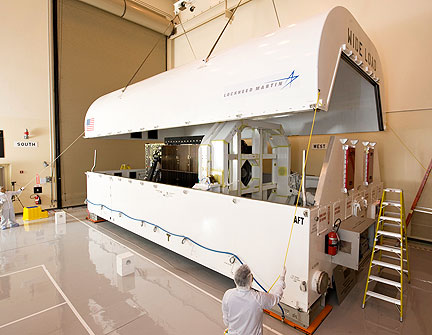
In Sunnyvale, Calif., Lockheed Martin engineers prepare the first geosynchronous (GEO-1) Space Based Infrared System (SBIRS) spacecraft for shipment to Cape Canaveral Air Force Station, Florida. Photo courtesy of Lockheed Martin.
The first geosynchronous (GEO-1) Space Based Infrared System (SBIRS) spacecraft has arrived at Cape Canaveral Air Force Station, Florida, where it will be prepared for an early May liftoff aboard a United Launch Alliance Atlas V launch vehicle. SBIRS GEO-1, with its highly sophisticated scanning and staring sensors, will provide the nation with significantly improved missile warning capabilities and support other critical missions simultaneously including missile defense, technical intelligence and battlespace awareness.

In preparation for shipment to the launch site, SBIRS GEO-1, in its container, is loaded onto the U.S. Air Force C-5 at Moffet Field in Sunnyvale, California. Photo courtesy of Lockheed Martin.
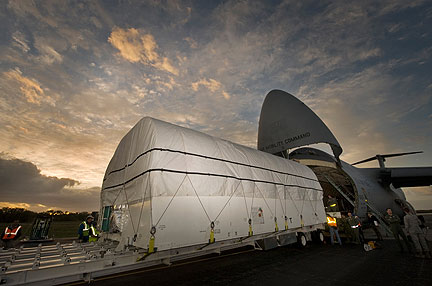
SBIRS GEO-1 is unloaded safely at Cape Canaveral Air Force Station, Fla., where it will be processed for an early May launch.
The 22nd Airlift Squadron of Travis Air Force Base, California, and the 129th Rescue Wing of Mountain View, California, provided critical support of the delivery of SBIRS GEO-1. The U.S. Air Force C-5 crew, commanded by Major Brad Silver, ensured GEO-1 was transported safely and efficiently to the launch site, and worked with the SBIRS government and industry team throughout the mission to monitor the payload and ensure its safe delivery. The 129th Rescue Wing, Security Forces Squadron secured the entire operation at Moffet Air Field prior to departure. The SBIRS team is led by the Infrared Space Systems Directorate at the U.S. Air Force Space and Missile Systems Center. Lockheed Martin is the SBIRS prime contractor, with Northrop Grumman, as the payload integrator. Air Force Space Command operates the SBIRS system.
[SatNews] Solar power will be the driving force behind the upcoming Juno mission.
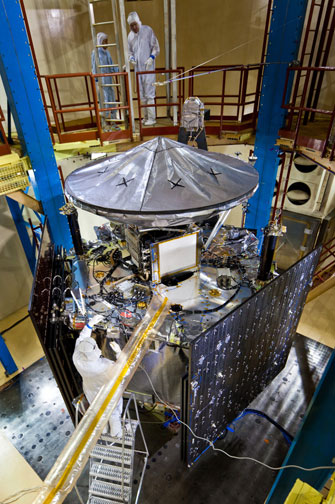 NASA’s Juno spacecraft is currently undergoing environmental testing at Lockheed Martin’s [NYSE: LMT] test facility near Denver, Colorado. The solar-powered Juno will orbit Jupiter’s poles 33 times to find out more about the gas giant’s origins, structure, atmosphere and magnetosphere. The launch window for Juno from the Cape Canaveral Air Force Station in Florida opens Aug. 5, 2011. In its present form, the spacecraft is fully assembled and all instruments have been integrated.
In the photo to the right, taken on Jan. 26, Juno had just completed tests that simulated the acoustic and vibration environment the spacecraft will experience during launch. The photo shows a Lockheed Martin technician inspecting the Jovian Auroral Distribution Experiment (JADE) instrument just after the test. All three solar array wings are installed and stowed and the large high gain antenna is in place on the top of the avionics vault. At present, Juno is sealed up in a large thermal vacuum chamber where it is being exposed to the vacuum and extreme hot and cold temperatures it will experience on its voyage to Jupiter. The two-week-long test will simulate many of the flight activities the spacecraft will execute during the mission. Juno is scheduled to ship from Lockheed Martin’s facility to Kennedy Space Center in early April where it will undergo final preparations for launch.
NASA’s Jet Propulsion Laboratory, Pasadena, California, manages the Juno mission for the principal investigator, Scott Bolton, of Southwest Research Institute at San Antonio, Texas. Lockheed Martin Space Systems, Denver, Colorado, is building the spacecraft. The Italian Space Agency in Rome is contributing an infrared spectrometer instrument and a portion of the radio science experiment.