

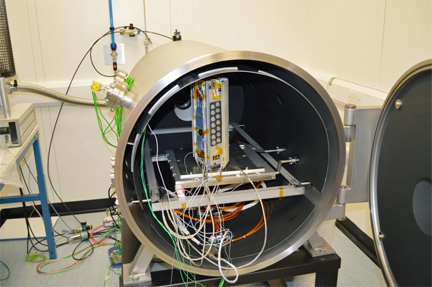
STRaND-1 in thermal vacuum chamber, photo courtesy of SSTL
...into space from India. STRaND-1 will fly the world's first smartphone in orbit and is the U.K.’s first launched CubeSat. The satellite flies a Google Nexus One smartphone, a new Linux-based high-speed processor, and attitude and orbit control system, plus two novel propulsion systems (eight pulsed plasma thrusters and a water-alcohol propulsion system). STRaND-1 is a training and demonstration mission 3U CubeSat (10cm x 30cm) weighing 4.3kg., developed by the Surrey Space Centre and Surrey Satellite Technology Ltd.
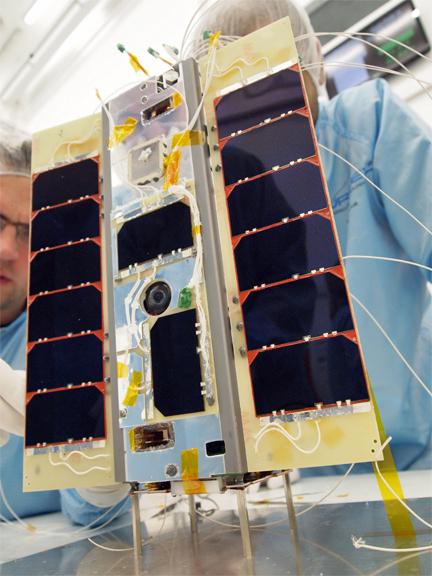
STRaND-1 flight ready in SSTL's cleanroom,
photo courtesy of SSTL
During the first phase of the mission, STRaND-1 will be controlled by the satellite’s attitude control system and a new high-speed linux-based CubeSat computer. During phase two, the STRaND-1 team plans to switch many of the satellite’s in-orbit operations to the smartphone, testing the capabilities of many standard smartphone components for a space environment. The smartphone has also been loaded with a number of experimental ‘Apps’, some serious and some just for fun.
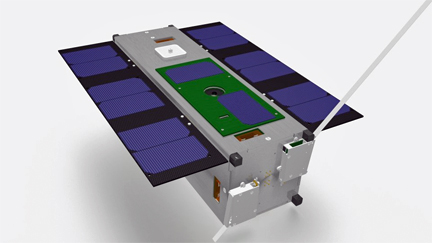
Artistic rendition of fully assembled STRaND-1,
courtesy of SSTL
STRaND-1 is being commissioned and operated from the Surrey Space Centre’s ground station at the University of Surrey and amateur radio operators can track it from all over the world. Details of the downlink frequency are available at www.uk.amsat.org and we radio amateurs world-wide are invited to track STRaND-1. Commissioning is expected to take approximately two weeks, with the switchover to the smartphone and the Apps having to wait until all the other systems onboard the satellite have been fully tested.
Apps on board STRaND-1 were developed by winners of a facebook competition held last year: iTesa will record the magnitude of the magnetic field around the phone during orbit. Used as a precursor to further scientific studies, such as detecting Alfven waves (magnetic oscillations in our upper atmosphere), the iTEsa app could provide proof of principle.
The STRAND Data app will show satellite telemetry on the smartphone's display which can be imaged by an additional camera on-board. This will enable new graphical telemetry to interpret trends.
The 360 app will take images using the smartphone's camera and use the technology onboard the spacecraft to establish STRaND-1's position. The public will be able to request their own unique satellite image of Earth through the website, where images can be seen on a map showing where they have been acquired at http://www.360app.co.uk/.
The b>Scream in Space app was developed by Cambridge University Space Flight and will make full use of the smartphone's speakers. Testing the theory 'in space no-one can hear you scream, made popular in the 1979 film Alien, the app will play videos of the best screams while in orbit and screams will be recorded using the smartphone's own microphone.