

....on January 15th over the Pasific Ocean, Russia’s space agency Roscosmos said on Saturday. Roscosmos said the spacecraft will fall within the eight-hour interval starting from 18:36 on Sunday Moscow time [14:36 GMT] to 2:24 on Monday [22:24 Sunday GMT]. The possible scatter zone is 51.4 degrees North latitude to 51.4 degrees South latitude. As of 2030 Saturday, the spacecraft was moving in the near-Earth orbit with an altitude that varied between 144.6 km at perigee and 167.1 km at apogee, the Russian space agency said.
According to the latest report from the U.S. Strategic Command, the failed probe would hit Earth's atmosphere between 17:26 Moscow time Sunday [13:26] and 03:02 Moscow time Monday [23:02 Sunday GMT]. It puts the altitude at between 138.1 km at perigee and 160.2 km at apogee. Rene Pischel, the head of the Moscow office of the European Space Agency (ESA), said the European agency’s specialists expect the reentry at 22:44 Moscow time on Sunday [18:24 GMT], give or take six hours. German amateur astronomer Harro Zimmer expects the reentry to take place at 21:22 Moscow time [17:22 GMT] on Sunday, give or take 90 minutes. His calculations put the reentry location at somewhere over the Pacific Ocean, northeast of Indonesia.
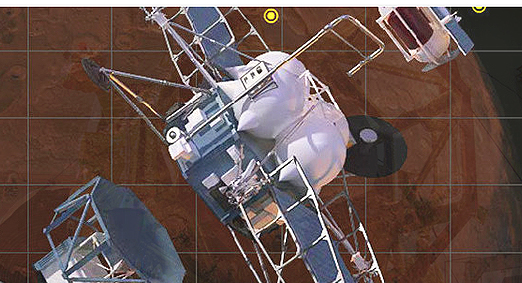
Phobos-Grunt, launched on November 9, was designed to bring back rock and soil samples from the Martian moon Phobos. Photo is © RIA Novosti
Phobos-Grunt, launched on November 9, was designed to bring back rock and soil samples from the Martian moon Phobos. However, it has been stuck in a so-called support orbit since its engines failed to put it on course for the Red Planet. The head of Russia’s Federal Space Agency (Roscosmos), Vladimir Popovkin, previously said the probe would break up during reentry into the atmosphere and none of the fragments are likely to reach the Earth. That includes the 13.5-ton spacecraft’s 7.5 tons of fuel, which are stored in aluminum tanks that are bound to explode upon reentry. According to NASA, Russia has failed in all 17 of its attempts to study the Red Planet close-up since 1960. The most recent failure before last month occurred in 1996, when Russia lost its Mars-96 orbiter during launch.
UPDATE: Additionally, Russia’s new Deputy Prime Minister Dmitry Rogozin said he will oversee the probe into the reasons of the Phobos-Grunt mission failure. “I am taking the investigation into the reasons for the Phobos-Grunt failure under personal control,” Rogozin, who had been Russia’s envoy to NATO prior to his appointment to the current post in December 2011, said on his Facebook page. The spacecraft was to explore one of Mars' two moons, Phobos. It reentered the atmosphere on Sunday. Russian Defense Ministry spokesman Alexei Zolotukhin said the probe fragments fell into the Pacific Ocean. A law enforcement source confirmed the report. However, a source in the space industry said — citing ballisticians — that the fragments fell in Brazil. Russian space agency Roscosmos has so far not commented on the place and time of the fall. Heiner Klinkrad, head of the space debris office of the European Space Agency (ESA), told RIA Novosti that ESA experts have no information on the Phobos-Grunt crash. (Source: RIA Novosti).