


[SatNews] “In the face a daunting weather forecast, the ULA Atlas V roared into the blue Florida sky today at the opening of the window – completing the company’s 2012 launch campaign.”
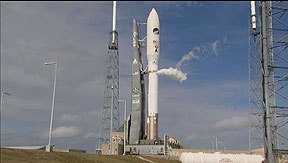
Cape Canaveral Air Force Station, Florida, (December 11, 2012) – A United Launch Alliance (ULA) Atlas V rocket successfully launched the third Orbital Test Vehicle (OTV-3) for the Air Force’s Rapid Capabilities Office (AFRCO) at 1:03 p.m. EST today from Space Launch Complex-41.
The OTV, also known as the X-37B, supports space experimentation, risk reduction, and concept of operations development for long duration and reusable space vehicle technologies. The first two OTV missions also were successfully launched by ULA respectively on April 22, 2010 and March 5, 2011.
"The ULA team is proud to have played a critical role in successfully launching these three important Orbital Test Vehicle missions for the Air Force RCO,” said Jim Sponnick, ULA vice president, Mission Operations. “This is a unique spacecraft since it is the first to launch on an Atlas V, return to Earth landing at Vandenberg Air Force Base in California, and then fly again on this mission.”
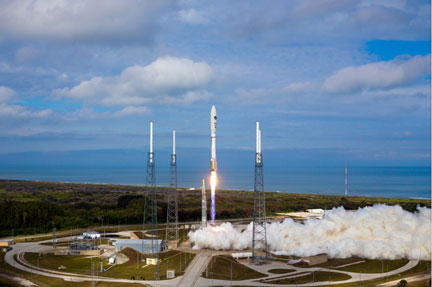
This launch completes the most aggressive campaign in the history of the Evolved Expendable Launch Vehicle (EELV) program with 10 missions launched during 2012, including eight launches from Cape Canaveral Air Force Station in Florida and two from Vandenberg Air Force Station in California.
This mission was launched aboard an Atlas V EELV 501 configuration vehicle, which includes a 5-meter diameter payload fairing. The Atlas booster for this mission was powered by the RD AMROSS RD-180 engine and the Centaur upper stage was powered by a single Pratt & Whitney Rocketdyne (PWR) RL10A-4 engine.
“I sincerely congratulate our OTV customer on today’s successful launch as well as our integrated team of mission partners that successfully accomplished ten critical one-at-a-time launches in 2012,” said Sponnick.
The EELV program was established by the United States Air Force to provide assured access to space for Department of Defense and other government payloads. The commercially developed EELV Program supports the full range of government mission requirements, while delivering on schedule and providing significant cost savings over the heritage launch systems.
ULA's next launch is the Atlas V TDRS-K mission for NASA scheduled January 29, 2013 from Space Launch Complex-41 at Cape Canaveral Air Force Station, Florida.
Boeing also made a statement as follows:
Boeing [NYSE: BA] today successfully returned an unmanned U.S. Air Force X-37B Orbital Test Vehicle to orbit, continuing to demonstrate how the system provides responsive, reusable access to space.
An Atlas V rocket launched OTV-1, the first of two vehicles in the program, into a low Earth orbit at 1:03 p.m. Eastern time from Cape Canaveral Launch Complex 41. The X-37B, which combines the best of aircraft and spacecraft design in an unmanned test platform, is testing reusable vehicle technologies dealing with space experimentation, risk reduction and concept-of-operations development.
“The second mission for OTV-1 demonstrates the vehicle is capable of multiple missions and affordable access to space,” said Paul Rusnock, vice president of Boeing Government Space Systems.
OTV-1 was first launched in April 2010 and returned to Earth that December. It is the United States’ first unmanned vehicle to return from space and land on its own. The space shuttle had been the only space vehicle capable of landing on a runway. A second vehicle, OTV-2, set a record for a reusable space vehicle in June of this year when it completed a 469-day mission. Previously, Space Shuttle Discovery held that record with an accumulated total of 365 days in orbit.
Boeing's commitment to space-based unmanned vehicle technology spans a decade and includes support to the Air Force Research Lab's X-40 program, NASA's X-37 program, and the Defense Advanced Research Projects Agency's X-37 Approach, Landing and Test Vehicle program.