

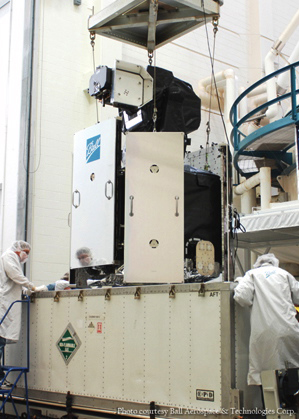
SBSS @ Ball Aerospace, photo courtesy of Ball Aerospace
The SBSS system passed a U.S. Air Force Mission Readiness Review this past September, demonstrating that it met requirements and was ready for a scheduled launch on Oct. 30. A hardware issue with the Minotaur IV rocket forced the Air Force to postpone launch until this summer. The Air Force led an effort to resolve the issue, and the first Minotaur IV was successfully launched from Vandenberg on April 22. The SBSS team maintained mission readiness during the delay by performing risk-reduction tasks that included additional operations exercises at Schriever Air Force Base, Colo., and testing at Ball Aerospace facilities. The team also initiated software enhancements to improve system performance.
Once on orbit, the SBSS system will provide significantly improved capabilities to track and monitor satellites, debris, and other objects in space that can threaten U.S. space assets that provide communications, navigation, weather forecasting, security, and other services. SBSS provides the Air Force with its only space-based capability for detecting objects without the limitations faced by ground-based sensors, such as weather and time of day. The satellite uses a digital sensor mounted on a high-speed gimbal to quickly find and track objects without having to reposition the entire spacecraft. Boeing is the prime contractor for the SBSS system, providing overall systems engineering and integration, the Satellite Operations Center, and initial mission operations. Ball Aerospace developed, designed, manufactured, integrated and tested the satellite and sensor, using an onboard processor and software from Boeing.