

...NASA’s Marshall Space Flight Center to permit the testing of the Elwing Company’s electrodeless plasma thruster technology at MSFC’s Propulsion Research and Development Laboratory. This represents the first agreement between the Elwing Group and the space agency. Elwing developed the electrodeless plasma thruster technology solely through the use of private funds. The Electrodeless Ionization Magnetized Ponderomotive Acceleration Thruster (E-IMPAcT) has been previously tested at the Electric Propulsion and Plasma Dynamics Laboratory at Princeton University.
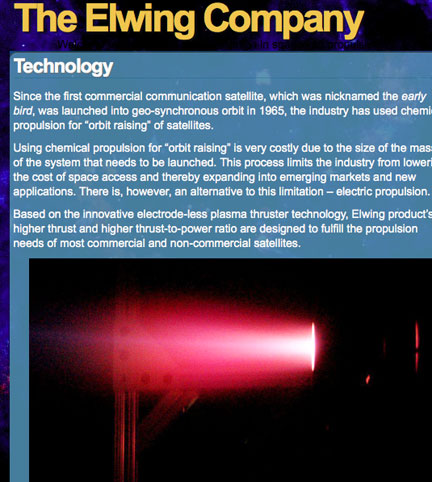 The E-IMPAcT technology, on which ELIGOS holds exclusive rights in the United States for government agency use, represents a departure from other electric propulsion systems, such as ion and Hall thrusters, that are currently available for use on commercial and scientific mission. The advantage of E-IMPAcT is that electrodes typically found in other plasma thrusters can be eliminated. These are often life-limiting components for thrusters and can be fragile, requiring special care in their design and handling.
MSFC’s Propulsion Research and Development Laboratory recently developed the Variable Amplitude Hanging pendulum with Extended Range (VAHPER) thrust stand, which has proven over a range of thrust levels from 1 milliNewton to 1 Newton to have very good measurement resolution of 0.1 milliNewtons. This thrust stand will be used to measure the thrust produced by E-IMPAcT to independently confirm and extend the measurements previously acquired in the Princeton laboratories. In addition, there is interest in electric thrusters that can operate on propellants that are storable and/or can be produced from in situ resources. E-IMPAcT’s electrodeless nature may permit it to utilize these types of resources that could quickly degrade and erode the electrodes in other electric propulsion systems. After baseline testing on standard noble gas propellants like argon and xenon, the thruster will be operated on a number of alternative propellants to gauge the performance (thrust, efficiency) on each.
The Elwing Company conceives, designs, develops, manufactures, and markets advanced propulsion systems for satellites. Established in 2002, The Elwing Company is privately held and has offices, affiliates and subsidiaries throughout the U.S. and in Europe. Elwing has been granted more than 20 patents in more than fifteen jurisdictions on its technology innovations, including U.S. patent 7,461,501 and European patent EP 1,460,267. Elwing is focused on primary leadership in the next generation of electric propulsion for spacecraft, opening the way for faster electric orbit-raising by leveraging its exclusive, patented technological breakthroughs.