- Harmonic Inc. (NASDAQ: HLIT) has announced that TV Azteca, the second largest broadcaster in Mexico, has deployed Harmonic’s IP-based video processing solutions to facilitate satellite distribution of its expanded HDTV service to hundreds of retransmission sites throughout Mexico and Central America. The new DVB-S2-based distribution system relies on Harmonic’s multifunction compression and stream processing solutions to reduce the cost of satellite uplink and transmission through more efficient use of the satellite bandwidth. TV Azteca is using Harmonic’s Electra® 7000 HD AVC encoders and the ProStream™ 1000 stream processing platform with DiviTrackIP™ statistical multiplexing and DVB scrambling to deliver secure, high-quality services while optimizing bandwidth efficiency. Harmonic’s ProView™ 7000 integrated receiver/decoders (IRDs) and ACE™ any-to-many real-time transcoding technology are used by TV Azteca for content reception and format conversion. Project integration and system installation were performed by Teletec de Mexico, SA de CV, a Harmonic reseller and systems integrator in Mexico.
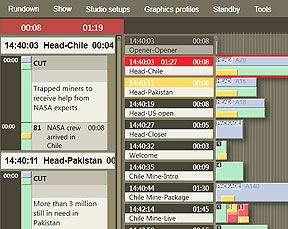
- Mosart®'s newscast automation solution in Europe has more than 70 percent of the market share and is the only open such system capable of working with all major systems and devices. This includes all leading video switchers manufactured by Snell, Ross, Grass Valley, and Sony. During the 2011 BroadcastAsia Show, Mosart Medialab AS will demonstrate Mosart Newscast Automation 3.0 featuring a completely redesigned graphical interface. Other enhancements include the ability to execute commands quickly via a touch screen monitor and updated implementation of ActiveX for the newsroom system. The product includes a range of new features and functions that further enhance the most versatile and powerful system on the market, including a completely redesigned graphical interface with full user configurability and the capability to store settings. Story elements such as cameras, clips, and graphics can easily be assigned to buttons for easy and quick access. A range of interface overviews can also be assigned to buttons, making the GUI a shot box for touch screens and adaptable for any TV production. Story scripts from the newsroom computer system are shown directly in the Mosart GUI, and Mosart operators can store clips and graphical elements in a pool ready for execution on request. Content repurposing/reuse and MAM integration are enhanced with Mosart's delivery of news as-run information to continuity control systems such as Snell's Morpheus. Through the news as-run integration, continuity and MAM systems are now able to reuse individual stories or events from earlier recorded Mosart productions. Mosart can also be user-configured to query MAM systems for metadata information. Mosart's open-systems compatibility is extended with new support for Dalet News and Annova's OpenMedia, in addition to ENPS, iNEWS, Octopus, and NorCom. Mosart now supports eight manufacturers of audio mixers, five manufacturers of vision mixers, seven brands of servers, four graphics systems, and five camera robotics systems.
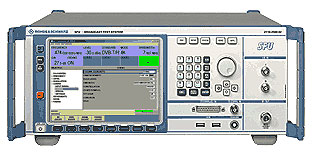
- Rohde & Schwarz has launched a DVB-C2 software coder for its R&S SFU signal generator. The coder enables manufacturers of broadcast receiver equipment and chipsets to perform standard-compliant tests on their products with DVB-C2 signals. Certification bodies and cable network operators can also use the new option. The R&S SFU already supports all common digital and analog radio and TV standards. Now it can handle all second-generation broadcast standards as well. As a result, users need only a single signal generator for all performance and compliance tests on broadcast receivers. The DVB-C2 digital broadcast standard was adopted about a year ago. At the end of last year, an initial DVB-C2 trial network was put into operation in Berlin. The first consumer electronics equipment is scheduled to be put on the market as early as summer 2011. To run performance and compliance tests on the new DVB-C2 receivers, manufacturers need a signal source that delivers standard-compliant test signals. Rohde & Schwarz has met this need by developing the DVB-C2 coder as a software option for its R&S SFU reference signal generator. Using this new option, manufacturers of TV sets, set-top boxes, tuners and broadcast-receiver chipsets can run all required DVB-C2 performance and compliance tests on their products. The R&S SFU supports the most important test standards, including the D-book test specifications of the Digital TV Group (DTG) as well as those of NorDig, the Scandinavian standardization organization. It is just as suitable for development work as it is for quality assurance in the production process. The instrument provides cable network operators, certification bodies and EMC labs with a reference signal generator for their tests. As the R&S SFU supports all common broadcast standards, users need only one instrument to test receiver components for a wide range of transmission standards. Even multistandard receivers, such as those for DVB-C/C2, DVB-T/T2 or DVB-S/S2, can be tested. By means of an option key, users can enable new standards as a software option.
- TeamCast, involved in digital modulation technologies for Digital Terrestrial Television (DTT), Mobile TV, and Satellite Transmission, has helped DNA Ltd, Finnish digital television operator to support their DVB-T2 network, the first commercial one in SFN. DNA Ltd, a digital television network operator in Finland, has taken up the challenge to deploy this new broadcast standard in the efficient SFN mode. TeamCast has developed — in an extremely short timescale (less than 18 months) — a range of fully proven DVB-T2 modulators and associative products, which fully meet both the demanding functional specifications for the network operating in SFN mode. In order to help the massive commercial deployment in Finland (HDTV experience with three HD multiplexes using DVB-T2 and MPEG-4 to cover more than 80 percent of all Finnish terrestrial TV households by the end of 2011), TeamCast has proposed its DVB-T2 modulators, having undertaken intensive development and testing of its capabilities and compliance to operate efficiently in SFN networks. These advanced DVB-T2 modules exhibits also Multiple Inputs, Single Output (MISO) transmission modes and Multi-service layered modulation allowing the processing of 8 parallel Physical Layer Pipe inputs (Multi-PLP). The implementation of several sophisticated technical parameters, developed with the highest speed and expertise by TeamCast, was able to meet the demanding time and performance requirements of the project.
Satnews Daily
May 16th, 2011
Harmonic + TV Azteca | Mosart | Rohde & Schwarz | TeamCast