Hubble Happenings... Catching A Runaway... (ESA)
Pictured is a heavy runaway star rushing away from a nearby stellar nursery at more than 400 000 kilometres per hour, a speed that would get you to the Moon and back in two hours, is the most extreme case of a very massive star that has been kicked out of its home by a group of even heftier siblings. Tantalizing clues from three observatories, including the
NASA/ESA Hubble Space Telescope’s newly installed
Cosmic Origins Spectrograph (
COS), and some old-fashioned detective work, suggest that the star may have travelled about 375 light-years from its suspected home, a giant star cluster called
R136.
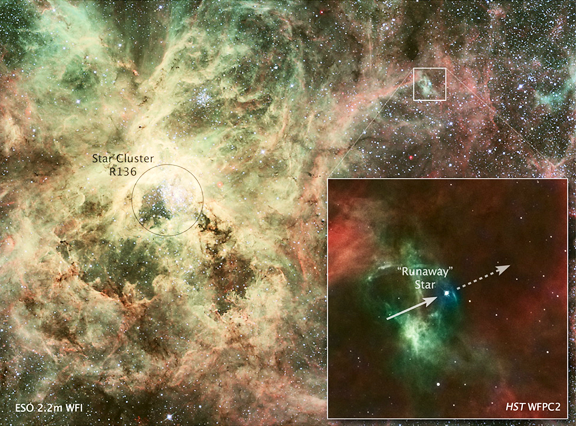
Image credit: NASA, ESA, C. Evans (Royal Observatory Edinburgh), N. Walborn (STScI) and ESO
The homeless star is on the outskirts of the
30 Doradus Nebula, a raucous stellar breeding ground in the nearby
Large Magellanic Cloud. The finding bolsters evidence that the most massive stars in the local Universe reside in 30 Doradus, making it a unique laboratory for studying heavyweight stars. 30 Doradus, also called the
Tarantula Nebula, is roughly 170 000 light-years from Earth. Nestled in the core of 30 Doradus, R136 contains several stars topping 100 solar masses each. The observations offer insights into how massive star clusters behave.
Topical Tags :
Regional Tags :

