

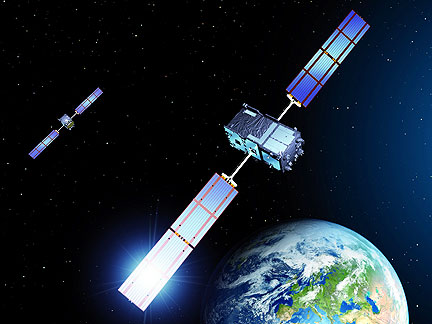
The first two of four Galileo In-Orbit Validation satellites are due for launch in August 2011. Image courtesy of the European Space Agency.
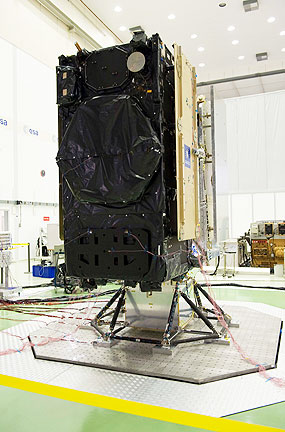
Galileo dispenser testing using the QUAD electrodynamic shaker during December 2010. The tests are using a qualification model of the dispenser, along with the with a pair of engineering models of Galileo IOV satellites, respectively the Structural Model (SM) and Structural and Thermal Model (STM). Credits: ESA
The satellites have been built by a consortium of European companies. Their payloads were designed, developed and assembled by EADS Astrium in Portsmouth, UK, with the overall satellite designed and developed by Astrium in Ottobrunn, Germany and assembled by Thales Alenia Space in Rome, Italy. The first satellite will endure simulated launch vibrations on ESTEC’s Electrodynamic Shaker, followed by the sudden pyrotechnic shocks during separation from the launch vehicle. Finally, it will take an acoustic battering matching the launcher’s sound pressure and frequency – imagine a squadron of fighter jets taking off 30 m away – in the Large European Acoustic Facility. The satellites will be transported to Europe’s Spaceport in Kourou, French Guiana, to be launched on Soyuz rockets. The PFM and Flight Model 2 will be on the first flight of Soyuz from Kourou, marking a double first for ESA.