

....a special retransmitting system that will assure online monitoring over spacecraft. Vladimir Popovkin, the head of Roskosmos, broached the issue in view of the unsuccessful mission of the Phobos-Grunt mission. He emphasized that it had not been clear why the rocket engines of the Phobos-Grunt failed to start. He did not exclude that an outside interference on the spacecraft could be a reason that led to the failure. “It’s incomprehensible why Russian spacecraft often go out of order when they are flying in the Earth’s shadow-side when we cannot see them and receive their telemetric data,” he said. Regardless of the given statement, there is a theoretical possibility of influencing a spacecraft in order to disable it, says editor-in-chief of the Moscow-based National Defence magazine, Igor Korotchenko. “In this case there could be several possibilities. Firstly, this could be done by exerting influence using specific rays. The question here is what should be used for this purpose. Secondly, this could be electromagnetic impulse that can put the onboard systems out of action."
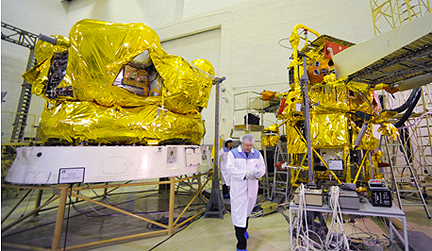
Phobos-Grunt. Photo: RIA Novosti
Undoubtedly, the new retransmission system will strengthen the possibility of monitoring and adopting crucial decisions in case of the appearance of circumstances beyond control. In these circumstances, an example in this area is the high-frequency satellite developed by Lockheed Martin. The U.S. Air force almost lost a two-billion dollar satellite, but ultimately a group of military and communication experts saved the satellite. It took two years for them to put the satellite into the planned orbit. In the end, it was discovered that a human error was the cause. A careless worker had left a piece of cloth in a flow passage.
Last year, Russia experienced four failures at the launches, and this prompted a discussion about poor control. Consequently, Roskosmos has done a huge amount of work to overcome the tendency of the failing reliability of rockets. As a result, the number of operations that have to be controlled thrice has been increased several times, including filming and video filming. Special groups have been set up which are engaged in searching for any deviation from technological processes. All stations that will test flight tasks will have stand-by systems. All this and other measures should produce positive results. (Source: The Voice of Russia.