

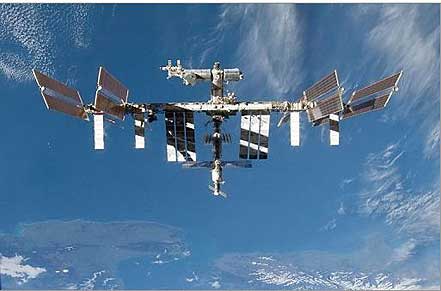
NASA image shows the International Space Station in 2009
As Congress wraps up its work before the summer recess, this much is clear: The president won't get the entire $812 million down payment that he requested to launch an unprecedented $6 billion effort over five years to ferry cargo and Houston-trained astronauts to the orbiting international space station via commercial enterprises.
But the Senate — and to a lesser extent the House — have signaled that the White House will probably get enough of its request in the $19 billion NASA budget to begin a historic change in direction for the space agency.
Up to now, NASA has relied exclusively on its own spacecraft — or NASA-contracted Russian rockets — to carry every American astronaut into orbit since John Glenn's breakthrough orbital mission in 1962.
"From the earliest days on the American frontier, commercial interests have always followed the steps of explorers," says Howard McCurdy, an American University scholar who wrote "Inside NASA: High Technology and Organizational Change in the U.S. Space Program."
"There's widespread political consensus now for the commercial space sector to have a go at transportation into low earth orbit."
Adds space historian John Logsdon, "This is a turn in the road toward where Obama wants to go."
Obama's proposed shift away from U.S. government spacecraft to reach orbit poses long-term challenges for Houston's Johnson Space Center, a facility that has served as mission control for every manned mission aboard U.S. government spacecraft since the early days of space exploration.
Impending retirement of the shuttle fleet alone has already prompted United Space Alliance, a major NASA contractor, to announce layoffs of 1,400 employees in Texas, Florida and Alabama who prepare shuttles for re-launch. NASA has contracted with Russia to carry U.S. astronauts and cargo to the space station until the United States deploys a crew-rated commercial spacecraft or a U.S. government successor to the shuttle, probably around 2015.
Added to that, Obama wants Congress to partly finance commercial delivery of astronauts and cargo supplies to the space station by killing the $108 billion Constellation program to return astronauts to the moon by 2020 aboard a U.S. government spacecraft — a program that accounts for an estimated 7,000 jobs at Johnson Space Center and among related contractors.
By, Stewart M. Powell, Houston Chronicle
The article is available here .