

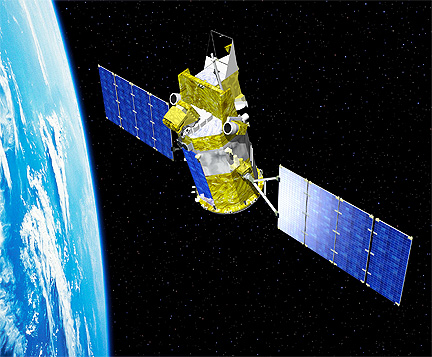
Artistic rendition of Glory satellite, courtesy of Orbital Sciences
Orbital will launch the 1,164-pound Glory spacecraft into a circular polar orbit approximately 340 nautical miles above the Earth, inclined at 98.2 degrees to the equator. Over the next several weeks, following the initial in-orbit spacecraft check-out procedures, Glory will employ its onboard propulsion system to raise its orbit to 438 nautical miles, where it will join a constellation of other NASA Earth-observing satellites known as the "A-Train" that fly in formation and cross the Equator every afternoon. Glory will be the sixth satellite in the A-Train, joining five other NASA satellites: Aqua, Cloudsat, Calipso, Parasol and Aura.
The Taurus XL rocket will also carry three Cubesats that will be deployed by a Poly Picosatellite Orbital Deployer (P-POD) mechanism. The Cubesat and P-POD project was developed by California Polytechnic State University to enable the development and deployment of tiny satellites that measure four inches cubed and weigh less than 2.2 pounds. The three Cubesats to be launched aboard the Taurus XL rocket were developed by college students from Montana State University, the University of Colorado and a consortium of several Kentucky universities. Orbital developed the ground-launched Taurus XL vehicle to provide a reliable and cost-effective means of launching satellites weighing up to approximately 3,000 pounds into low-Earth orbit. The Glory mission will be the ninth flight of the Taurus rocket program.