

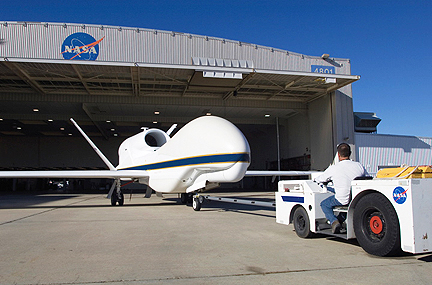
NASA's Global Hawk UAV for scientific projects, photo by Tony Landis
The GloPac mission flights revolutionized the collection of data in the stratosphere. Fitted with 11 science instruments, Global Hawk acquired and transmitted data that has never before been accessible through either manned flights or satellites. Flights reached up to 65,000 feet where information was collected from the air as well as the water and polar ice below. Data from the science instruments were downloaded in real-time to NASA Dryden Flight Research Center where scientists were able to analyze the data, and if necessary, ask the Global Hawk pilot to adjust the flight path to optimize data collection. Flights during the GloPac project ranged from north of the Arctic Circle, over polar ice, down to Hawaii near the equator. NASA Global Hawk completed 82.5 flight hours, with one particular flight lasting 28.6 hours, eight hours of which was spent north of Alaska over the polar ice. Additionally, this was the first time a Global Hawk unmanned air vehicle has flown as far as 85 degrees north latitude.
The flights were designed to address several science objectives, including validation and scientific collaboration with NASA Earth observation satellite (EOS) missions, principally the Aura satellite, also built by Northrop Grumman. The GloPac payloads collected atmospheric data in the same location at the same time as Aura and other EOS missions to compare and combine results. A Space Act Agreement between NASA Dryden Flight Research Center and Northrop Grumman established a partnership to re-fit and maintain two Global Hawk aircraft transferred from the U.S. Air Force. As part of the Northrop Grumman/NASA partnership, the company contributed to the GloPac missions by developing the GloPac mission plans; confirming aircraft performance through extensive analysis; providing pilots and training for NASA/NOAA pilots; sharing maintenance and operations support; and developing and building a new ground control station and software for aircraft operations. Additionally, under a contract from NASA, Northrop Grumman performed aircraft modification engineering and analysis for installation of the science payloads, which was funded by the science sponsors for each of the 11 sensors. Later this year, NASA Global Hawk will examine hurricanes and their formation process. This experiment will explore the possibility of improving hurricane forecasts. The Global Hawk aircraft is proving to be the premier platform for use in high-altitude, long-duration Earth science missions.