

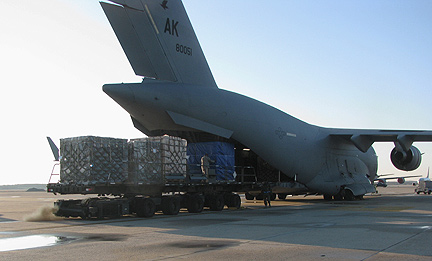
The TacSat-4 ensemble is readied at Andrews Air Force Base for transport aboard a C-17 Globemaster to Kodiak, Alaska. This C-17 is based in Elmendorf, Alaska and operated by the 3rd and 176th Wings of the USAF. Source: U.S. Naval Research Laboratory
The work is being completed to ready the TacSat-4 spacecraft for a May 2011 launch. Transported March 1 to the Kodiak Alaska airport via an Air Force C-17 and trucked to the Alaska Aerospace Kodiak Launch Complex, the TacSat-4 satellite will be launched aboard an Orbital Sciences Minotaur-IV launch vehicle into a highly elliptical orbit (HEO) with an apogee of 12,050 kilometers. TacSat-4 augments current SATCOM by providing communications-on-the-move (COTM) for existing radios without requiring antenna pointing and providing 10 Ultra High Frequency (UHF) channels that can be used for any combination of communications, data ex-filtration, or Blue Force Tracking, a system that provides military commanders and forces with location information about friendly military forces.
TacSat-4 provides flexible up and down channel assignments, which increases the ability to operate in busy, and sometimes restrictive, UHF environments. The unique orbit of TacSat-4 also augments geosynchronous SATCOM by providing near global, but not continuous, coverage to include the high latitudes. "The ability to provide communications on the move without having to stop and point a SATCOM antenna was the most important user requirement and one which drove the design of the system," said Mike Hurley, section head, NRL Spacecraft Development.
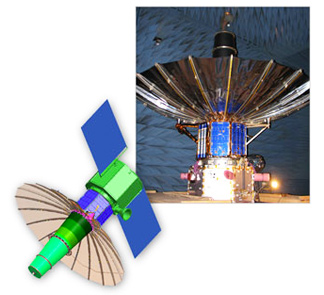
TacSat-4 spacecraft
The spacecraft bus was built by NRL and Johns Hopkins University Applied Physics Laboratory (APL) to mature ORS bus standards developed by an Integrated (government and industry) System Engineering Team, the "ISET Team," with active representation from AeroAstro, Air Force Research Laboratory, Johns Hopkins Laboratory APL, ATK Space, Ball Aerospace and Technologies, Boeing, Design Net Engineering, General Dynamics AIS, Microcosm, Microsat Systems Inc., Massachusetts Institute of Technology Lincoln Laboratory, Orbital Sciences, NRL, SMC, Space System Loral, and Raytheon.