

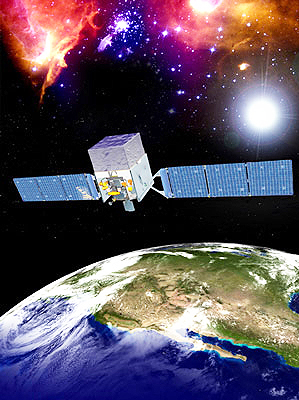
 [SatNews] Orbital Sciences Corporation (NYSE: ORB) is celebrating the second anniversary of the launch of the Fermi Gamma-ray Space Telescope spacecraft, which has performed flawlessly over the initial two years of its mission to supply scientists with important new data about the nature of the universe. In the second year of operation the spacecraft, which is based on the mid-class low-Earth orbit platform that Orbital recently acquired, established an overall system availability of 100 percent, providing continuous scientific data and enabling the mission team to lower costs by reducing staff needed for routine spacecraft operations.
The spacecraft began its mission known as GLAST (Gamma-ray Large Area Space Telescope) when it was launched in June 2008 and was later renamed in honor of famed physicist Enrico Fermi. Its two payloads, the Large Area Telescope (LAT) and the Gamma-ray Burst Monitor (GBM), have been continuously mapping and providing data on the sources of gamma rays, the most energetic form of radiation in the universe. The LAT maps the cosmos for gamma rays using a "Sky-Survey" mode of operation, in which it maps the entire gamma-ray sky every two orbits, or just over a three-hour period, providing scientists with a continual picture of the dynamic gamma-ray universe. For the past two years, the Fermi space-based observatory has been generating a rich stream of data for the scientific community, providing the basis for numerous publications and symposia. The Project Scientist for the Fermi mission, Julie McEnery, notes that each month scientists are publishing an average of almost 30 new papers based on data from the Fermi spacecraft.
In November 2009, approximately 450 scientists and space enthusiasts from around the world gathered in Washington, D.C. to present and share the many discoveries found during the first year of Fermi operations. Symposium subjects ranged from the discovery of new gamma-ray sources, such as blazars and supernova remnants, to the nature of mysterious dark matter and even observations of high-energy gamma rays emitted by thunderstorms. Fermi also monitors millisecond radio pulsars, precise natural clocks that may allow the first direct detection of gravitational waves and can allow us to position Earth in the cosmos as a kind of "galactic GPS."
The Fermi spacecraft is built on a platform engineered and constructed by the General Dynamics satellite unit that Orbital acquired in April 2010. The acquisition brought 325 new employees and a state-of-the-art 135,000 square foot space systems manufacturing, integration and test facility under Orbital, which now offers a comprehensive range of small- and mid-size space systems to meet the needs of the scientific, defense and intelligence, and commercial space communities for low-Earth orbit and geosynchronous orbit missions.