

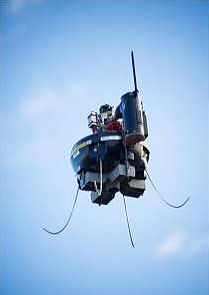
 [SatNews] Inside the troubled Fukushima Daiichi nuclear facility, the T-Hawk brings crucial views to those attempting to negate this ongoing disaster...
Honeywell’s (NYSE: HON) T-Hawk Micro Air Vehicle (MAV) is helping emergency workers at Japan’s Fukushima Daiichi nuclear facility get up-close video and photos inside the plant as they work to limit further radiation releases. Three Honeywell employees, trained to fly the unmanned T-Hawks remotely, have flown five successful missions and captured hours of video and dozens of photos of the nuclear reactor. The four T-Hawks in service at Fukushima Daiichi have been adapted to carry radiation sensors.
“On behalf of all of us at Honeywell, our hearts go out to the people of Japan, particularly those who have suffered as a result of the earthquake and tsunami that damaged the Fukushima Daiichi nuclear plant and surrounding areas,” said Tim Mahoney, president and chief executive officer of Honeywell Aerospace. “At Honeywell, we are proud of our commitment to safety and security, and we are grateful that our technologies can be deployed now to help the people of Japan in this historic time of need.”
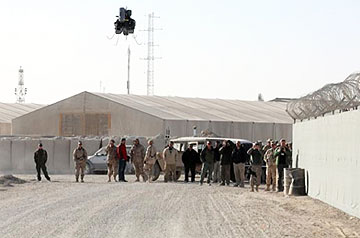
The RQ-16A T-Hawk unmanned aerial vehicle hovers over a group of coalition forces and civilians, during a technical display performed by Honeywell at Kandahar Airfield. Technicians from Honeywell International invited coalition forces to witness how the miniature air vehicle can be be used on routine operations. (U.S. Army Photo by Spc. Jonathan W. Thomas)
Weighing just 17 pounds, the T-Hawk is a ducted-fan vertical takeoff and landing air vehicle originally designed in conjunction with a Defense Advanced Research Projects Agency (DARPA) Advanced Concept Technology Demonstration (ACTD) program. Pilots can determine manual or autonomous flight paths from up to six miles away for as much as 40 minutes at a time. The T-Hawk is a proven force multiplier in Afghanistan and Iraq, where systems have been averaging more than six hours of flight time a day. The T-Hawk is used in Afghanistan for route clearance, infantry assault, and explosive ordnance disposal missions, where, together with its similar work in Iraq, it has cumulatively flown more than 17,000 hours. The United Kingdom’s Ministry of Defence also deploys the T-Hawk for combat missions in Afghanistan and trains with the T-Hawk in Afghanistan and Jordan. The T-Hawk is currently being tested for urban use by the Miami-Dade Police Department.