

 [SatNews] Aerojet Rocketdyne, a GenCorp (NYSE: GY) company, has revealed that its propulsion systems played a major role in successfully placing the sixth Wideband Global SATCOM (WGS-6) spacecraft into orbit for the U.S. military.
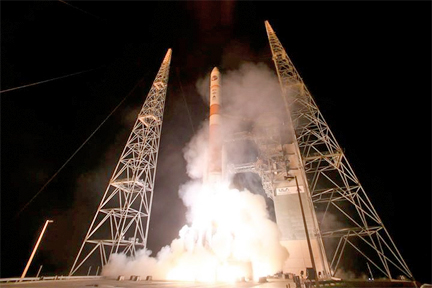
The recent launch of WGS-6, photo courtesy of ULA.
A single RL10B-2 engine delivered 24,750 pounds of thrust to power the upper stage, which was powered by cryogenic liquid hydrogen and liquid oxygen propellants. For more than 50 years, the RL10 has been one of the United States' most reliable upper-stage engines, accumulating one of the most impressive lists of accomplishments in the history of space propulsion and has played an integral role in placing numerous military, government and commercial satellites into orbit, and powering space-probe missions to nearly every planet in the solar system.
Twelve Aerojet Rocketdyne monopropellant (hydrazine) thrusters in four modules on the Delta IV upper stage provided roll, pitch and yaw control as well as settling burns for the upper stage main engine. The Aerojet Rocketdyne's High Performance Apogee Thruster (HIPAT) was used for orbit insertion.
The WGS satellites are part of a larger system that increases military communications capabilities for U.S. and allied forces deployed worldwide. They help support the exchange of information, execution of tactical command and control, intelligence, surveillance and reconnaissance.