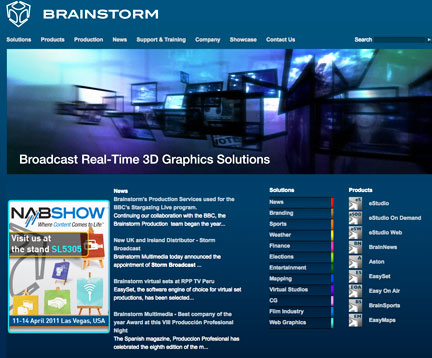
- At NAB 2011, Brainstorm Multimedia is showing EasySet12, one of the Company's latest developments within its "Easy" product family, which vastly simplifies virtual set design. EasySet12 is a simple to use, yet sophisticated and cost-effective trackless virtual set solution. It offers a comprehensive 3D real-time environment with up to four SD/HD inputs, all from just one PC. In addition to bringing in external video feeds, virtually every popular image file format can be imported, making the EasySet12 very open to the integration of external content. EasySet12 comes with an expandable library of 18 virtual sets and each one can be totally customized by modifying colors, textures, the size of objects, animating elements, inserting live video, and many other options. Visitors to Brainstorm's booth can participate in a demonstration of EasySet12, and will also have the opportunity to view live demos of Brainstorm's entire product range including the latest version of the flagship product and graphics engine eStudio V.12. Also to be featured at NAB will be the latest version of the Aston Character Generator, plus the sophisticated, template-based news graphics system BrainNews, which enables news departments to integrate Brainstorm's real-time 3D graphics into their workflow without the need for constant input from designers. Easy OnAir Graphics, includes a spectacularly intuitive toolset for live streaming of graphics based on building highly creative designs on pre-defined templates, no matter how complex they may be.
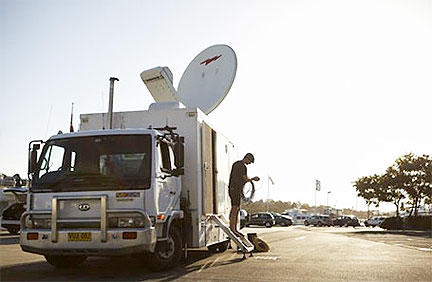
- Ever since the launch of the first 24 hour television news service over 30 years ago, news channels have played an increasingly important role in the daily viewing habits of TV consumers, bringing round the clock news from across the globe. To meet growing consumer demand for greater quality coverage, such as HD news services, Ericsson (NASDAQ: ERIC) has developed Voyager II, the most flexible and scalable news gathering product on the market. Ericsson ConsumerLab studies, which focus on how consumers act and what they think about telecom and TV products and services, show that 93 percent of people are still watching scheduled ‘linear’ broadcast TV every week, of which news and sport play a central role. Voyager II is Ericsson’s fifth generation DSNG product. Built upon a new and revolutionary hot-swappable 1RU chassis with color input confidence monitoring, it features a fully redesigned intuitive front panel user interface based on industry feedback. It is the first solution to unleash the power of MPEG-4 AVC 4:2:2 encoding with 10-bit precision at up to 1080p50/60 resolutions to the DSNG market. Offering the widest range of video processing options, it allows users to scale their event coverage from SD to HD and even multichannel and 3D, delivered across a multitude of satellite and terrestrial networks. Voyager II extends the Ericsson compression team’s history of firsts in the market. In 1995, the team developed the industry’s first MPEG-2 DSNG solution, enabling news organizations to send digital video back from the field and use less satellite bandwidth. The team continued this innovation in 1998 with the first HD MPEG-2 demonstration – making the highest picture quality affordable for satellite and cable operators, and in 2004 launched the first MPEG-4 AVC HD encoder – making the business model work for HDTV worldwide.
- New Media Legend, one of Russia's principal suppliers of uplink services for pay-TV platforms and channels, has selected the 36 degrees East satellite neighborhood operated by Eutelsat Communications (Euronext Paris: ETL) for a new broadcasting platform providing Russian and international channels to complement the NTV Plus and Tricolor TV platforms. Following the signature of a long-term contract with Eutelsat, the new participation program, called Scene, is using two transponders at 36 degrees East. The launch of Scene adds further impetus to the neighbourhood that New Media Legend describes as Russia's most popular satellite TV position. Over seven million homes in Russia as far as the Urals are already equipped with antennas pointing to 36 degrees East for DTH reception of the NTV Plus and Tricolor TV platforms. Scene is opening a new opportunity for channels, that already include NHK World TV and Europa Plus TV, to reach into Russia's vibrant TV market.
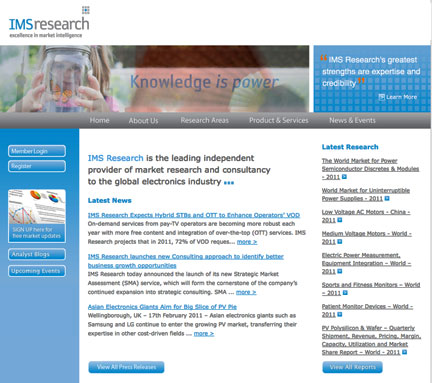
- On-demand services from payTV operators are becoming more robust each year with more free content and integration of over-the-top (OTT) services. IMS Research projects that in 2011, 72 percent of VOD requests via payTV platforms will be free transactions. OTT content delivered via STBs will account for a fair share of free transactions, as well as generating a forecast US$48 million for pay-TV operators this year. IMS Research examines the changing dynamics in the on-demand market in 30 countries in its recently-published global study, On-demand Services Business Models: Video, Games & Over-the-Top – 2011 edition. Study author Anna Hunt states, “OTT services are becoming one of the biggest threats to traditional payTV operators, and with devices such as smartphones and tablets proliferating the marketplace, consumers are quickly becoming accustomed to on-demand multimedia consumption. Offering a variety of on-demand services is now essential for digital TV operators that want to retain market leadership status.” Common strategies of pay-TV operators include offering free on-demand content to subscribers of certain digital bundles and offering catch-up TV services via set-tops or online, and over the next couple of years, integrating OTT services into the set-top box for seamless multimedia delivery to subscribers. IMS Research forecasts that in 2016, OTT services delivered via pay-TV set-tops will generate $436 million in worldwide operator revenues. In addition, direct-to-home (DTH) service providers are deploying IP-enabled hybrid set-top boxes to allow for more on-demand content delivery. Hunt adds, “In 2010, we estimate that 37 million IP-enabled hybrid set-tops shipped worldwide, with 42 percent of these being satellite boxes. This equipment is allowing satellite TV operators to stay competitive with cable TV and IP networks, which are better suited for 2-way interactive services such as VOD.” IMS Research forecasts that the cable TV segment will account for the majority of on-demand service revenues over the next five years, although its share will decrease from an estimated 66 percent in 2010 to a forecast 53 percent in 2016, mainly due on-demand service uptake on the satellite TV platform.
- Motorola Mobility Inc. (NYSE: MMI) has announced that Home Box Office (HBO) Latin America will upgrade its satellite network using MPEG-4 video encoding and DVB-S2 8PSK advanced modulation to launch all MPEG-4 programming. The solution compresses, encrypts, modulates, and receives the HD signals within a single integrated transmission system to allow HBO Latin America to expand its HD offerings to subscribers. It also features many distribution system enhancements developed collaboratively between HBO Latin America and Motorola. HBO Latin America will use Motorola's SE-5100 encoder to process HD video content and convert it to MPEG-4 format for distribution via satellite to affiliates. At the affiliates' downlink sites, the content will be received and processed real-time with Motorola's new DSR-4460 digital satellite receivers and DSR-6300 multi-channel integrated receiver/transcoders (IRDs) as part of the consolidated network-wide upgrade to MPEG-4 and, eventually, all-HD service distribution. HBO Latin America will use Motorola's uplink control system to execute a well-designed technology transition strategy. The new multi-format IRDs can be signaled to seamlessly transition from MPEG-2/QPSK to MPEG-4/8PSK services. The DSR-6300 IRD features a three-service MPEG-4 HD input that efficiently delivers content to the home in QAM-friendly transport bitrates, significantly increasing the number of services that can be delivered over a standard cable 256-QAM feed. The DSR-6300 also uses AFD (Active Format Descriptor) to translate input HD services to an appropriate standard definition (SD) service with proper aspect ratio and resolution. The DSR-4460 includes an MPEG-4 HD or SD input and a composite video SD output that also uses AFD. Both models of satellite receivers derive SD channels from the HD source, allowing programmers to free up additional bandwidth by transmitting the HD signal.
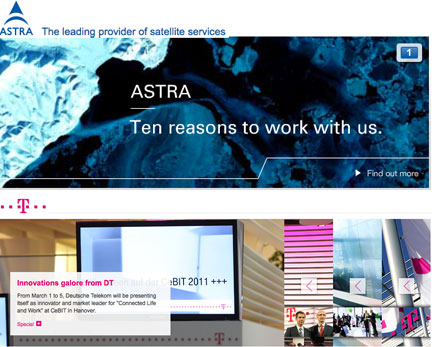
- SES ASTRA, an SES company (Euronext Paris and Luxembourg Stock Exchange: SESG), is cooperating with Deutsche Telekom in Germany to combine ASTRA`s broad satellite free-TV offer — including HD+ — with Deutsche Telekom`s IPTV product Entertain. The offer will include all free-to-air, TV and radio channels in SD + HD on ASTRA including HD+ as well as the typical Entertain services such as Video on Demand, a TV archive, and an Electronic Program Guide. Entertain Sat also comprises time shift functions and hard disk recording with 500 GB memory. Flat rate telephony and Internet will also be included. Entertain Sat will be available for households all across Germany with a DSL connection of at least 3 Mbit/s. HD+ is a platform launched by SES ASTRA in Germany for access to free-TV programs in HD. The HD+ offer currently comprises eight German private free-TV programmes in HD: RTL HD, Vox HD, RTL2 HD, ProSieben HD, Sat.1 HD, kabel eins HD, Sport1 HD and sixx HD.
- KEYE-TV, the CBS affiliate in Austin, Texas, has deployed a Utah Scientific GS-4000 graphics station to add to its branding capabilities and to simplify master control workflow. KEYE master control operators use the GS-4000 to display HD time and temperature, an Associated Press news crawl, and sniping during live programming. Because the Utah Scientific graphics station has made it easier for KEYE to add new ticker crawls, it has also helped the station attract revenue through their sponsorship. Utah Scientific's new GS-4000 works with the company's MC-4000 master control switcher to support graphics, including fixed text, multiple text crawls, still and animated logos, sniping, and time and temperature displays. With it, text and branding graphics can be created and saved using a simple composition screen — no sophisticated coding skills required. For KEYE, the Utah Scientific GS-4000 solved another problem with the previous system: Master control operators couldn't input school closure updates fast enough to keep the ticker crawl current. This year when unusually snowy weather hit the region, the GS-4000's simplified workflow enabled KEYE to provide timely, accurate information to students and parents. More advantages include the system's automated retrieval of local temperatures from the National Weather Service and news from the Associated Press.
Satnews Daily
March 1st, 2011
Of Interest to SatBroadcasting™ Professionals...