

...but not by much. The 50m space rock is expected to come closer than many satellites, highlighting the growing need to keep watch on hazards from above. An amateur team discovered the unusual asteroid, dubbed 2012 DA14, on February 22nd. Its small size and orbit meant that it was spotted only after it had flown past Earth at about seven times the distance of the Moon. However, current predictions indicate that on its next flyby, due on February 15, 2013, it will pass Earth at just 24,000 km, closer than many commercial satellites.
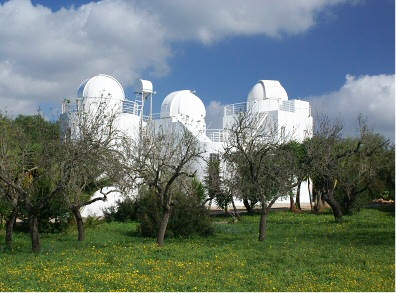
Observatorio Astronómico de Mallorca
The team use several automated telescopes to scan the sky, and the discovery came somewhat serendipitously after they decided to search areas of the sky where asteroids are not usually seen. "A preliminary orbit calculation shows that 2012 DA14 has a very Earth-like orbit with a period of 366.24 days, just one more day than our terrestrial year, and it 'jumps' inside and outside of the path of Earth two times per year," says Jaime. While an impact with Earth has been ruled out on the asteroid’s next visit, astronomers will use that close approach for more studies and calculate the Earth and Moon’s gravitational effects on it. "We will also be keen to see the asteroid’s resulting orbit after the next close approach in order to compute any future risk of impact," says Detlef.
The La Sagra Sky Survey is operated by the Observatorio Astronomico de Mallorca and has recently joined ESA’s SSA program. In the future it will provide observations to the asteroid data hub that ESA is developing. Together with information on space weather and debris, its information will help European scientists and policy-makers understand and assess hazards, particularly if an Earth-threatening asteroid is ever found.
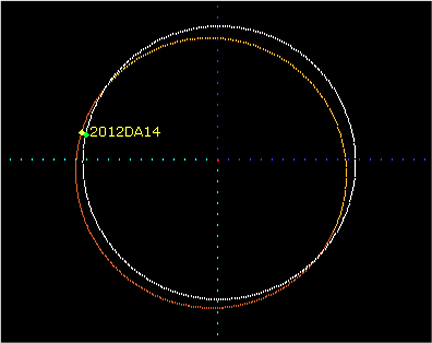
In this plot, the asteroid is the yellow dot, and Earth is green; the two orbits intersect twice per year. A preliminary orbit calculation shows that 2012 DA14 has a very Earth-like orbit with a period of 366.24 days, just one more day than our terrestrial year, and it ‘jumps’ inside and outside of the path of Earth two times per year. While an impact with Earth has been ruled out on the asteroid’s next visit, astronomers will use that close approach for more studies and calculate the Earth and Moon’s gravitational effects on it. Credits: Deimos-Space
The discovery of 2012 DA14 is particularly significant for the Agency’s SSA office, as it is typical of the estimated half a million undiscovered near-Earth objects up to 30 m across. “The goal is to be able to spot them at least three weeks before closest approach to Earth. We are developing a system of automated optical telescopes that can detect asteroids just like this one, with the goal of being able spot them at least three weeks before closest approach to Earth," says Detlef. To achieve this, ESA specialists supported by European industry are planning a network of 1m-diameter telescopes with a combined field of view large enough to image the complete sky in one night. The work is continuing under the Agency’s Space Situational Awareness Preparatory Program.