Orbital Sciences... Glory, Glory, Hallelujah (Satellite)
[SatNews] Orbital Sciences Corporation (NYSE: ORB) has announced that the Glory satellite has arrived at Vandenberg Air Force Base, CA, to be integrated with the company’s Taurus® XL rocket that will launch the satellite into low-Earth orbit in late February.
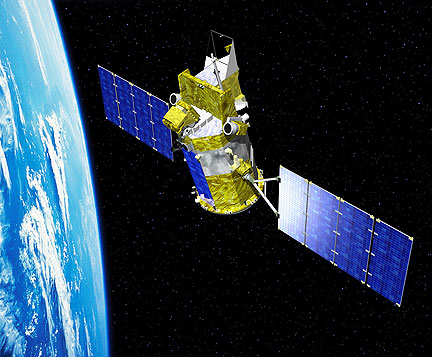 The Glory satellite, image courtesy of Orbital Sciences.
Built by
Orbital for the
National Aeronautics and Space Administration (
NASA), the
Glory satellite is the latest in an extensive series of Earth science satellites that Orbital has designed, developed, built and tested for NASA since the early 1980’s. Orbital’s
Space Systems Group designed, built, and tested the Glory satellite at its Dulles, VA satellite production facility. It is based on the company’s
LeoStar™ small satellite bus that has served as the baseline platform for several previous successful NASA science spacecraft programs, including recent missions such as
GALEX,
SORCE and
AIM. The satellite weighs approximately 1,160 lbs. (525 kg.) and features deployable solar arrays, three-axis stabilization, and X- and S-band communications capabilities. The Glory mission is being led by NASA’s
Goddard Space Flight Center under the direction of Project Manager
Bryan Fafaul and Project Scientist
Michael Mishchenko. The spacecraft carries two primary instruments, the
Aerosol Polarimetry Sensor (
APS), which will measure aerosols in the atmosphere, and the
Total Irradiance Monitor (
TIM), which will point toward the Sun and continue a 32-year data record of the Sun’s brightness, or total solar irradiance.
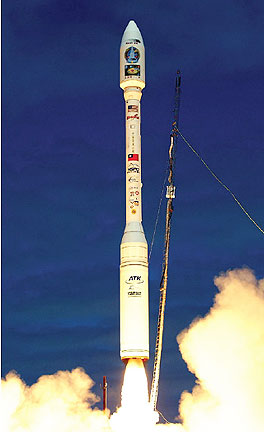 Orbital's Taurus launch vehicle is a ground launched variant of Orbital’s Pegasus® air-launched space booster. Image courtesy of Orbital Sciences.
Orbital developed the ground-launched four-stage
Taurus XL vehicle to provide a reliable and cost-effective means of launching satellites weighing up to approximately 3,000 pounds into low-Earth orbit. Taurus XL incorporates advanced structural and avionics technology proven on the company’s Pegasus® rocket and other operational launch systems. It is also designed for easy transportability and austere site operations, offering customers rapid-response launches from a wide range of locations around the globe. The Glory mission will be the ninth flight of the Taurus rocket, with six of the previous eight missions having been fully successful. It also marks the Taurus XL’s “return to flight” following a launch failure in 2009 during which the fairing encasing the satellite failed to properly separate from the rocket, preventing the satellite from achieving orbital velocity. Orbital has identified and corrected the root cause of the fairing separation problem and has since carried out three fully successful space launch missions using the updated fairing separation system. The Taurus XL launch system maintains its launch vehicle reliability certification from NASA, enabling the space agency to launch satellites of high value and importance aboard the system. It joins Orbital’s
Pegasus rocket, as well as the
Delta II and
Atlas V rockets, as the only launchers to have earned that distinction.
Topical Tags :
Regional Tags :

