

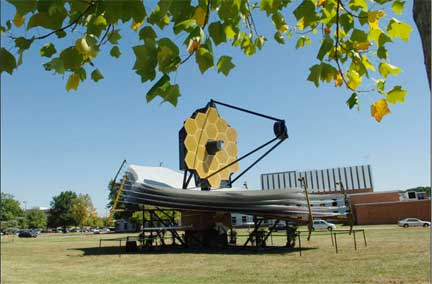
A mockup of the James Webb Space Telescope, photo courtesy of NASA.
...to NASA and the European Space Agency on May 9, 2012, at the Institute of Engineering and Technology in London. MIRI, a pioneering camera and spectrometer, will allow astronomers to explore the formation of planets around distant stars and could even pave the way for investigations into the habitability of other planetary systems. Following the formal acceptance, MIRI will be shipped from STFC’s Rutherford Appleton Laboratory to NASA’s Goddard Space Flight Center as the first of the four instruments for the James Webb Space Telescope (JWST) to be completed. The successor to Hubble, JWST is scheduled for launch in 2018.
This event marks the acceptance of MIRI as a finished component of JWST following the rigorous testing it has undergone to ensure it can survive to journey four times further away from the Earth than the Moon. The success of these tests is a culmination of the work done by teams across Europe and the U.S. The U.K. took responsibility for the overall science performance, the mechanical, thermal and optical design, along with the assembly, integration, testing and calibration of MIRI.